Showing posts with label Jung. Show all posts

Saturday, May 30, 2020

The sacred flame

Sacred Heart (Mexico)
[Image from StardustPrintShop (Etsy)]

At this point it becomes easier to understand why Jung always required of analysts that they should ultimately work the most on continuing to make progress in their own individuation. In doing so, they take their analysands along with them on their journey, without trying to influence them directly (which would be an abuse of power). In an early letter, Jung even goes so far as to say that the therapist should only analyze the pathological aspect of the patient’s psyche. This is because intellectual understanding is destructive. Understanding (Latin comprehendere), after all, means “taking hold of,” “grasping,” and this corresponds to an exercise of power. When the patients being and destiny are at stake, one should relate to his unique mystery with wordless respect. As Jung said, “we must understand the divine in us, but not in another in so far as he is capable of getting on and understanding on his own.” Our dreamer, as we will recall, was apprehensive about his encounter with patients. His dream points him back to working on himself
~ Marie-Louise von Franz, Psychotherapy

I thought about the secrets I had stored up inside my body. How many times I’ve crawled out my bedroom window to get in a car. The unstoppable fire between my legs. A fire not his. I thought about vodka. Nearly drowning. By the time he sat me on the couch to tell me I was his, I was miles away from daughter. A black suitcase making shape and story in my dreams. I felt like there was a muscle between us. The muscle was my sexuality. Not his.
~ Lidia Yuknavitch, The Chronology of Water


Welcome the madnesses, the stalemates, the gordian knots. Even though it's hard and painful, welcome these burdens. What you see as the Great Enemy who is trying to ruin all of your carefully laid plans is really your severe and demanding Guardian Angel, providing obstacles that will train your spiritual body into something strong and beautiful. Our madnesses are the Self trying to incarnate in us, God trying to come into the world.

The shaman is always a wounded healer. Those who can go into their own madness and come out of it whole are the only ones who are able to carry the weight of the Self into life. This is the important thing; your weakness is your strength. What is weak in outer, subjective reality is the yoke that links you with the Self. It is your way to bring the Self, or as much of it as you are able, into the world.

To understand boorishly and without care is to do violence to the soul. That desire in us - to know, to control, to make safe - diminishes that which is sacred into a “nothing but.” It turns what is glorious and beautiful and terrible into bland meaninglessness. Hindu’s greet each other with palm to palm, bowing as the God in them acknowledges the God in you. When we, or someone else, is experiencing madness, we put our hands together wordlessly, reverently, bow to this holy presence that is trying to come into the world. It’s not the places where we’re strong that matter, but where we are embarrassing, unpleasant, and inconvenient.

What is needed is a reverent attitude toward life, toward ourselves as well as others, toward all of existence. An open-hearted and open-minded attitude, an attitude of sympathy and compassion when we're in the thick of the struggle. Not everything needs to be known, or judged.... measured, or fit into “it's place.” Reverence stops us from harming ourselves and each other with our drive to put everything into safe little boxes. The thing in us which is bigger than the universe cannot be fit into a small, neat little box. By freeing our hearts and our minds we remember the Sacred that lives in and through us all.

The thing in us which is ours is ours. The thing in others which is theirs is theirs. We can - and should - clash and disagree, fight and struggle. But, at the same time, we must most of all always recognize and honor the Sacred that is laboring to birth itself into the world.


Thursday, April 23, 2020

MBTI: How to type


[Image from Art.com]


This is the most important, but often one of the more difficult, things to do. Unless you know your actual type nothing else you try to do with the MBTI will work because it won’t be for you. It’s not easy; if this is new to you there’s a lot to learn. Even for someone like me, an INTP who loves figuring things out, it’s taken years. Luckily for you, though, I’ve done a lot of the work... but none of that will matter unless you do your part. Figuring out your type isn't easy, but most things that are worthwhile aren't.

If you still want easy though you can always take a free test. There are plenty of MBTI tests online - I've linked some of the better ones below - but there are problems. The main one is that many, if not most, of these tests were created by people who explicitly reject Jung and his ideas because they're trying to make the MBTI more acceptable to the scientific community. But when you cut the MBTI off from it's roots all you're left with is a cheap personality quiz that isn't much better than the “Which Harry Potter character are you” type quizzes your cousin loves to post on FaceBook.

When you cut the Jungian foundation off the MBTI what you're left with is a trait sorter. But there's a serious problem with this; the same trait can be caused by many different things. For example, many different shapes can cast the same shadow, but to know anything about the shape itself you need to know more than just the shadow. Knowing the volume and surface area will allow you to figure out the shape, with a little bit of work. In a similar way, knowing the functions and the function roles will give you the information you need to figure out your psychological “shape.” For this reason, even if you do decide to just take the test it's still necessary to confirm your results by making sure that the functions and roles of that type are actually your functions and roles.

[Original image from Commack School District, concept from Linda Berens [1]]

The biggest problem with trait based tests, in my opinion, is that people of different levels of psychological health exhibit very different, even opposite, traits. For example, unhealthy INFPs can be unproductive, pessimistic complainers... but healthy INFPs are self-reliant, committed, dedicated, and effective forces for good. In other words, they start looking like their antipodal type, in their case a really chill ESTJ. So, this person who exhibits the traits of both a healthy INFP and a healthy ESTJ, are they an INFP? Or an ESTJ?

The only way you can really tell is by looking at the cognitive functions and the core complexes; no matter how healthy they are an INFP is always going to be confident about being in their INFP, and nervous about being in their ESTJ, and vice versa. Why is this even important though? Because the INFPs path to growth is completely different from every other type, even their sister type the ENFP; their weak spot is completely different, their area of hypocrisy that they need to work on is completely different, everything is different. Each type is unique.


So what's your type?
“Science, when it’s done the way it’s supposed to be, simply means learning about reality and changing it by investigating it, accumulating evidence by interacting with reality, identifying the patterns in reality, and then moving to change it on that basis. That’s all science is! Not something more mysterious or frightening.”
- Bob Avakian [2]

When trying to figure out your own psychology it’s vital that you look at what you actually do, not what you think you is the “right” answer, or what you wish you were like. Everyone wants to think well of themselves! It's totally natural! It's really hard to have the level of self-awareness that's required; and even if you are totally honest, you can't know about things you don't know. There's going to be new stuff here, things you never thought about until someone else tells you. This is why it might be beneficial to have someone who knows you well (and will be honest with you) as a sounding board. It's almost always easier to see others clearly than it is to see yourself, you have less at stake.

The best way to type yourself and others, and to understand them when you do type them, is to have a solid Jungian foundation. This means the functions, the function roles, and the core complexes. Not only will you type yourself and others accurately, you will be able to take what you have learned and help yourself, and maybe even others, grow and develop. Once you come to understand your type, your strengths, your weaknesses, you will be able to figure out what it is that you need to do.

Jung always insisted that what he was doing was science. I'm not sure exactly what he meant by it, but to me this simply means; is it true or not? Is this something that actually exists? That's all that this process is; what are your observations? What's the pattern? Does the pattern hold when you test it? How can I apply this pattern to the world? What further things do I learn when I do so? What you are going to be doing here is exactly this. It's not something to be nervous about, it's just something we humans have been doing for as long as we've been human.

If you'd like some help with the process I will, at some time in the (near!) future, be offering coaching. I'd like to get certified first (to give you Te types something you can trust). And of course I need to complete this series on the fundamentals of the MBTI as well. But once I do I will be offering coaching for those who are interested.


The process

[Image from Sarah & Bendrix]

Overview
  1. What's your house? Which attitude of each root function is in your consciousness? Ni or Ne? Ti or Te? Si or Se? Fi or Fe?
  2. What are your strongest and weakest functions? Which of the root functions (intuition, thinking, sensation, or feeling) are your strongest? Which two are your weakest? This will tell you which side of the house you're on (e.g. INFP/ENFP or ISTJ/ESTJ in Rowan).
  3. What type are you? After narrowing it down to two sister types, look at which cognitive function is in which function role.
  4. Confirm that this is actually your type.

What's your house?

The first step is to figure out which of the psychological functions are in your consciousness; this is what a house is, the types that share the same four conscious functions. For each pair of branch functions - Si/Se, Ni/Ne, Fi/Fe, and Ti/Te - one of them will be in your conscious and the other in your unconscious. Read the descriptions of the functions. Choose the ones that seem better, more correct, more accurate, more true; and which one seems off the mark, not really that important or just not as important as the other.

Some roles - the hero/ine and especially the anima/us - will be obvious. The mirroring nemesis and the daimon functions feel wrong, especially the nemesis. The daimon can feel wrong, or it can feel like it simply doesn't matter. The parent and the child, however, tend to be less clear than the hero/ine and anima/us, especially the parent. When looking at the parent and child functions it might be better to look the mirroring critic and trickster functions as they're generally more obvious. The critic and trickster functions are in one's unconscious however, so the other function is the one that's in your consciousness (e.g. if your critic is Ni and your trickster is Se, then the two conscious functions will be Ne and Si.)

Make sure the functions are in their proper function axes (plural of axis). Each branch function (Si, Te, etc.) is always connected with it's antipodal (opposite) function; opposite judging or perceiving, and opposite attitude. If you have introverted sensation, you must also have extroverted intuition. Intuition is the opposite perceiving function as sensation, and extroversion is the opposite attitude as introversion. The same holds for the two judging functions, feeling and thinking.


A useful way to think of the function axes is if the judging and perceiving functions were 2 seesaws. Let's use the perceiving axis as an example; if one side of the seesaw (sensation) is down then the other side (intuition) will be up, and vice versa. If one side is introverted then the other will be extroverted. The same holds for the judging functions (thinking and feeling). This will always be the case and is why you can use it as a test; is one side of the axis is introverted and the other extroverted?


If one half of the axis (Si) is in your consciousness then the opposite end (Ne) will be as well. The two ends are attached to each other. So if you don't have Si and Ne, if you have Si and Ni instead, then one of them is wrong and is actually in your unconscious. Same with the other axis. In that case go back and look at the functions again. If you're still unsure just pick the one that seems best and continue on but keep the other function in mind. When you get to the stage of looking at the function roles, see which one fits better. Examining the functions in their roles will confirm (or not) your choice.

These are the four function axes:


Once you have your functions and function axes you know your house. Read the description of the house. Does this sound like you? Note any feelings that come up, whether of affirmation or rejection and what specifically it is that you're affirming or rejecting. If you need to go back because you were unable to confirm your type this will give you an idea of what to look for. And even if you get your type right the first time, knowing these things about yourself will help you better understand yourself, and what direction you may need to look when working on yourself.

Function axes and houses

The cognitive functions
The houses
House Ash
House Yew
House Oak
House Rowan


Example: Mr. X

Mr. X is interested in figuring out his MBTI type. He's read the posts on the psychological functions and the function roles and he has an idea of what his hero and anima functions are because he immediately felt that Te was very important to him. He reads over the descriptions of the functions again. Again, Te is is a very strong “yes” for him; he really despises wasting time trying to figure every little thing out (Ti), it's much more important to him to just get stuff done. He looks at the opposite root function of thinking, which is feeling. If Te is in his consciousness then Fi should as well. This means he should reject Fi's mirror, Fe. He skims the description of Fe and sure enough, it's a strong “no” from him; he couldn't give a flying flip what others think of him. However, the thought that he might be a bad, immoral person (Fi) makes him want to run away. This means that Fi probably is in his consciousness (in the role of his anima), while Fe's probably in his unconscious as his daimon.

Next he turns to the two other functions, sensation and intuition. He's not so sure of them. He cares about looking nice and having a pleasant physical environment (Se) and about being conscientious and careful (Si). Same with intuition; he actually has a fun-loving side (Ne) though few people would believe it. And he thinks he knows what he wants (Ni). Everyone knows what they want, right??

Since he's stuck, he thinks about which of the four functions could be his critic; where is he the harshest and most judgmental? He looks over the descriptions of the four branch functions and decides that it's probably Se; there's nothing he hates more than seeing someone wearing sloppy, dirty clothing, or obviously not taking care of themselves. He takes the time needed to make sure he looks professional and presentable, why can't everyone else???? People should stop being so lazy!! So Se is probably his critic function. That means that Ni should be his trickster. He thinks back; he does have a really hard time making up his mind about things he wants, something his close friends have teased him about on more than one occasion. He decides that this seems right to him.

Since his critic is Se and his trickster is Ni, two roles that are in his unconscious, their mirror opposites, Si and Ne, should be in his conscious. As he's already decided that Te and Fi are in his conscious that means that his house is Rowan (Te/Fi and Si/Ne axes).

[Image from Dark Horse Comics]


What are your strongest and weakest functions? 

Which two root functions (sensation or intuition? thinking or feeling?) are you strong at, and which two are you weak at? You will have one strong judging function, and one weaker one, the same for perceiving. The weaker two functions are generally very easy - glaringly easy - to spot. Especially the inferior anima/us function, which is always painful and intimidating even when integrated. The child function is weak but you don't really care, but the anima/us function is our place of shame and deep pain. It's pretty hard to miss.

Doing this will tell you which “side” of the house you're on. Each house has a split where two types are good at the same two functions, and the other two are good at the other two functions. In House Ash, for instance, the split is between sensation/feeling (ESFJ and ISFJ) and intuition/thinking (ENTP and INTP). In the example from earlier ("is the person in question an INFP or an ESTJ?"), this will tell you which one you are since the two types are on opposite ends of House Rowan. If you have absolutely no idea, though, it will at least narrow it down to the two sister types (e.g. INFP/ENFP). Below are the splits within each of the houses:

Ash
Sensation/Feeling is ISFJ & ESFJ
Intuition/Thinking is ENTP & INTP

Oak
Sensation/Feeling is ESFP & ISFP
Intuition/Thinking is INTJ & ENTJ

Yew
Sensation/Thinking is ESTP & ISTP
Intuition/Feeling is INFJ & ENFJ

Rowan
Sensation/Thinking is ISTJ & ESTJ
Intuition/Feeling is ENFP & INFP

This will also help with any confusion you may have had in the previous step; if you're not really sure which branch function is your parent and which is your child, the parent will be one of the two stronger functions and the child will be one of the two weaker functions.

Example: Mr. X

Mr. X looks at the four root functions; sensation, intuition, feeling, and thinking. He knows that he's confident in his thinking, and that he's extremely lacking in confidence in his feeling. Of the two perceiving functions, he decides that, while he really enjoys his little adventures traveling the world and driving his muscle cars (Ne), he's actually much better at being careful, thoughtful, and contentious (Si), though he sometimes pays less attention to this part of life than he probably should. He has a tendency to charge ahead without taking the time necessary to think things through carefully. But he feels more confident in this area of his life, so his stronger functions are probably thinking and sensation, and his weaker ones are intuition and feeling. This means he's either an ESTJ or an ISTJ.


What type are you? 

After narrowing it down to two sister types, compare the roles of the functions for the types. The easiest ones to spot are the anima/us and trickster; it's very hard to hide those. After those two roles the heroine, nemesis, critic, child, parent, and daimon are the easiest to figure out, in approximately this order. All you really need are two or three function roles, once you have them you can figure where everything else falls, but the rest of the roles should corroborate your type.

In the example of INFP/ENFP, an INFP will have Te animus and Se trickster, while ENFPs have Si animus and Ti trickster. This means that if you really worry that you are ineffective and will die without having done anything good or important, and you tend to struggle with physical reality (tripping, running into things, stuff like that) you're probably an INFP. But if you struggle with the everyday grind - the boring, daily drudgery - and you worry that you're kind of dumb, or others have told you that you're a real airhead, you're probably an ENFP (this isn't to say that ENFPs are dumb, far from it, but that they don't have logic in their thinking, it's aaaalll about effectiveness; in other words, “truth is just a concept, everyone has their own 'truth,' what matters is whether or not you get stuff done.”) The child function can also be very useful; do you really enjoy farting around, doing a whole lotta nothing? You probably have Si child, making you an INFP. Or do you prefer to be active, specifically do you really enjoy organizing things, and maximizing efficiency (Te)? In that case, you're probably an ENFP.

MBTI types and functions

This is the stage where, if we struggled to figure out our conscious functions in the first step, we confirm or reject our choices in that step. The parent in particular can be a bit of a challenge as its often the function that we actively run away from having to use. This is a sign of psychological immaturity; many, probably most, people try to do an “end run around” the uncomfortable parent function. However, we usually glory in wielding our critic function, beating others over the head with it like a cudgel. The difficulty comes from differentiating the critic from the parent. In my experience, the parent & critic, more than the other three relationships (hero/ine & nemesis, child & trickster, and anima/us & daimon), appear to be fused. In all four relationships the unconscious role seems to act through the conscious role, but none more so than the critic.

If you're still struggling another option is to triangulate the parent by looking at the critic, child, and trickster functions, which are usually much more obvious. The trickster is one of the first functions you want to look at. If you think you know which one is the trickster, look at it's mirror function (Se if your trickster is Si, Te if your trickster is Ti, etc.) Does this sound like the child to you? Do you feel that it's something you're not that good at but you really enjoy doing, especially when you want to relax and feel good? In the posts linked to below, “The function roles” are descriptions of the roles, while the post “Functions + roles” are brief sketches of each cognitive function in the 8 different roles.

One very important thing to keep in mind: just because you think something is important doesn't make it your dominant (hero/ine) function. I think being a good person, and kind to others, is the most important thing in the world but that doesn't make me an Fe type. What it means is that I've integrated my Fe animus function. A similar thing happens with the parent function sometimes; when I was first trying to figure out my own type I wasn't sure if if my heroine was thinking or intuition. I knew that they were my two strongest functions, and that sensation and feeling were my two weakest, but not which one was which. The clincher was the animus; while I knew I was bad at sensation and was kind of embarrassed sometimes I was absolutely terrified of making a social faux pas, and absolutely devastated when I invariably did so.

As we move around the circle of our personality we integrate the functions, and as we integrate the various functions we live that function with all it's strengths and weaknesses. As we move into each of the complexes we think and feel like the type of that complex. But this doesn't change our fundamental personality; our strengths and weaknesses, our areas of hypocrisy, where we love to nurture and where we want to be nurtured. It doesn't change our spiritual task. In order for us to fulfill our purposes as human beings - to bloom into the astonishing, unique flower that we were meant to be - we need to know what our actual path is.

The function roles
Functions + roles
Integrating the four functions

Example: Mr. X

Mr. X already thinks he knows his type - ESTJ - because it's pretty clear to him that of his two strongest functions, Te and Si, Te is the strongest. He knows this because of how easy it was for him to identify Te and Fi as his hero and anima functions; Fi is definitely his anima function, he has no doubt. And the description of Te describes him... to a "T" (lol). This would naturally make him either an ESTJ or an ENTJ, the two types that have dominant Te. He's in House Rowan, though, so that should make him an ESTJ. He needs to look at the rest of the functions in their roles to confirm this.

He reads over the descriptions of the functions + roles: parent Si, child Ne, nemesis Ti, critic Se, trickster Ni, and daimon Fe. The critic, nemesis, and trickster functions ring true for him. He's not so sure about the daimon though but that's not surprising as it's very hard role to see in ourselves. That fact in and of itself validates putting Fe in the daimon role. The type that has Te hero, Fi anima, Si parent, and Ne child is ESTJ. Now he needs to confirm that that's actually his type (step 4, the next step). He reads the description of his type, including the core complexes of his sodality. After reading this he decides that his choice is correct, he is an ESTJ.


Confirm that this is actually your type

Go and read the description of the type. Look at the core complexes for the type; one thing to remember with types is that we can “live” in any of our core complexes. You can have a very INFP INFP, or you can have an INFP who lives in their ESTJ a lot. They still have their core INFP ego but they are extremely practical and concerned with security. This is actually a quite common. In fact, I'd say that most people of average or even low-average psychological maturity usually integrate their P2 anima/us complex by mid-life, sometimes even earlier. If someone lives in a core complex other than their P1 ego this will make it more difficult to type them simply based on their personality traits. This is why it's so important to look at the functions.

So look at the functions and the core complexes for the type you think you are. Does this sound like you? Do other people think this sounds like you? If it doesn't go back and see where you might have gone wrong. Even when you get things wrong, though, it's not a waste. If you're atypical of your type, why might that be? Is there something you need to work on? Or is this showing an area of health in your psyche? Every piece of information is valuable, everything tells you something. If it does sound like you... CONGRATULATIONS! You can now get to work. 😀

The core complexes


One final thing: the MBTI's four letter code

I wasn't sure where to put this, but this post seems the most logical. What do the four letter of the MBTI types mean? This is actually something that I didn't understand for years, lol. It seems pretty obvious; the first letter is whether the person is introverted or extroverted. The second letter is whether sensation or intuition are stronger. The third letter tells you whether thinking or feeling are stronger (remember two of the root functions will be stronger - one judging and one perceiving - and the other two will be weaker.)  It's the last one that's confusing, the J or the P. What does “being a judger or perceiver” actually mean?


There's a lot of stuff in the MBTI-sphere about the difference between “judgers and perceivers;” judgers are organized on the outside and disorganized on the inside, while perceivers are more organized on the inside, and disorganized on the outside. Judgers tend to easily lose track of their thoughts and have a hard time finding an idea again if they've been distracted. Perceivers, on the other hand, are able to find things quickly in their minds, as if they had an mental filing cabinet. On the outside, however, it's the judgers who have everything neat and tidy, with “a place for everything and everything in it's place,” while perceivers are generally more casual and indifferent.

But what makes a “J-type” a J? Or a P-type a P? For example, ISTP's have introverted thinking - a judging function - as their dominant function. Why aren't they ISTJs?? Same with ISTJs, their dominant function is a perceiving function, introverted sensation. In fact, it's the same for all introverted types; if a type is introverted the P or J at the end of their type doesn't refer to their dominant function. What's going on here???


Let's start with something easy; ESTP, an extroverted type:

E:   Dominant extroversion
ST: Their dominant perceiving function is sensation, dominant judging is thinking
P:   Of the two dominant functions - sensation and thinking - sensation, the perceiving function,
      is extroverted

So, in an ESTP extroverted sensation is the dominant (hero/ine); introverted thinking is the secondary function (parent); the tertiary function is the opposite judging function, feeling (the child); and the last function, opposite the hero/ine, is introverted intuition (anima/us).


How about ESTJ, the other extroverted type with dominant sensing and thinking?:

E:   Dominant extroversion
ST: Their dominant perceiving function is sensation, dominant judging is thinking
J:   Of the two dominant functions - sensation and thinking - thinking, the judging function,
      is extroverted

In an ESTJ extroverted thinking, the judging function, is the dominant (hero/ine); introverted sensation is the secondary function (parent); the tertiary function is intuition (the child), and the last function is introverted feeling (anima/us).

As you can see extroverted types are pretty straightforward. The problem is the introverted types. The thing you have to remember is that the final letter doesn't refer to the the hero/ine function. The final letter indicates which of the two dominant functions is extroverted. Let's take a look at the ESTPs sister type, the ISTP.


I:    Dominant introversion
ST: Their dominant perceiving function is sensation, dominant judging is thinking... just like the
       ESTP
P:   Of the two dominant functions - sensation and thinking - sensation, the perceiving function,
      is extroverted... also just like the ESTP

As you can see, the ISTP is very similar to ESTP; both have dominant extroverted sensation and introverted thinking. But which of the two functions is the hero/ine? The introverted function; (“I.”) That means that introverted thinking is the dominant (hero/ine); extroverted sensation is the secondary function (parent); the tertiary function is intuition (the child), and the last function is extroverted feeling (anima/us).

It was John Betts excellent podcast on Jungian psychology that finally clarified things for me. He describes the hero/ine function as the captain of a ship, and the secondary parent function as the captain's first mate. In an extrovert the captain is very friendly and outgoing; she's extroverted. She spends most of her time mingling with people, maybe even invites you to her table for dinner. If you need to talk with her for some reason she meets with you directly. This is why what you see in an extroverted person is exactly what they are; you see their dominant function. In the case of the ESTP, you meet her dominant extroverted sensation.

An introverted person is different; with them, you never directly meet the captain. The captain, the dominant heroine function, is introverted. Therefore, whenever she needs to interact with the passengers she always sends out her first mate to run interference for her. In the ISTP this would also be extroverted sensation. However, Se is the ISTP's secondary function, their parent function. It's not really who they are, it's not their ego. When you interact with an introvert you aren't seeing who the person actually is as their hero/ine function is turned inwards. This can make introverted types seem a bit more awkward than extroverted types as what you're really dealing with is their second strongest function.

This is the reasoning behind the MBTI's naming convention. Although its confusing initially it's actually a more accurate way of referring to the types as it clearly shows the connection between the sister types (ESTP/ISTP, ESTJ/ISTJ, etc.) The two are very similar and can look very similar to an outside observer, especially if they've done some maturing and have integrated their parent function.

Antonia Dodge, “What is a 'Judger,' and What is a 'Perceiver?'” (Personality Hacker)
John Betts, “Type1,” “Type2,” and “Type3” (The Jung Podcast, episodes 11, 12, & 13)
     John gives the metaphor of the hero/ine as a captain in “Type3” (ep. 13)


So now you should know your type! Figuring out one's type is often a long, complex process, with many challenges. However, as it's crucial to get your type right it's a necessary and worthwhile endeavor. The absolute best way is to study the fundamentals of the theory, fundamentals that come from some really brilliant, deep thinkers, like John Beebe and CG Jung. In fact, the process of figuring out one's type is itself one of the very best ways to learn the MBTI.

Allow this to be an amazing learning experience, one where you not only explore this fascinating, important area of the human mind and soul, but also to learn about yourself, as well as those who are important to you. Let this be something that makes you a better, more complete person.


Links

The Cognitive Functions
The Function Roles
Functions + roles
The Houses
The Core Complexes
Working with the MBTI
My MBTI story


Tests

HumanMetrics
IDR Labs
Personality Hacker


Other resources

CS Joseph (YouTube)
Michael Pierce, Function Axes playlist (YouTube)
Michael Pierce, The Sixteen Types playlist (YouTube)
Michael Pierce, The Types Revisited (YouTube)
Or go to the Resources page for more


References

1. Linda Berens, The Sixteen Personality Types (Telos Publications, 1999)
2. Bob Avakian, “Science and the New Communism, Prisons and COVID-19” (YouTube)


Tuesday, March 10, 2020

Reference: “The Hidden Source of Self”

[Image from Down Home Essentials]

"We are not human beings having a spiritual experience. We are spiritual beings having a human experience."

~ Pierre Teilhard de Chardin

This is the full text of the subchapter of the book that one of the quotes from the post on projection comes from. It’s really great, very useful, so I’m including it here. Very well worth the read, as is anything from my favorite Jungian, the analyst Marie-Louise von Franz.


We probably project all the time, in everything we do; in other words, in addition to those other impressions which are conveyed by the senses, there are always psychosomatic influences from within, so that we have a general impression of our experiences; Gestalt psychology demonstrates this in many individual cases. Therefore we must either widen our concept of projection to such an extent that, like the East Indians, we look upon everything as projection; or we must draw a line between what we will refer to as projection and what is a relatively objective statement concerning outer objects. Jung suggested that the concept of projection be applied only where there is a serious disturbance of adaptation, that is to say, where either the person who is doing the projecting or all those in his immediate vicinity unanimously reject the statement in question. For the usual mixture of subjectivity in our image of reality, a mixture which is limitless, Jung uses the expression archaic identity, archaic because this was man’s original condition, namely one in which he saw all psychic processes in an “outside” – his good and evil thoughts as spirits, his affects as gods (Ares, Cupid), and so on. Only gradually were certain psychic processes, which were visualized before as exclusively “outside,” understood as processes within the experiencing subject himself, as for instance when the Stoic philosophers began to interpret the goddess Athena as insight, Ares as aggressive passion, Aphrodite as desire; this, so to speak, was the beginning of an “incarnation” of the gods in man.

How far such a process can go – a process, that is, of an increasing development of consciousness – is therefore not easy to foresee. We still know pitifully little about objective man, as Jung emphasized time and again. In spite of being disturbing and socially dangerous, projections also have meaning; for it is apparently only through projections that we can make ourselves conscious of certain unconscious processes. Through projections there arise, first of all, those fascinations, affects, entanglements which then force us to reflect on ourselves. There is no becoming conscious without the fires of emotion and suffering. The disturbance of adaptation which is closely linked with every projection leads, if all goes well, to reflection (if it goes badly it leads to homicide and murder.) Re-flexio, however, means that the image which has been “radiated” outward onto another object is “bent back” and returns to oneself. It is just because the symbol of the mirror has to do psychologically with the phenomenon of projection that it has, mythologically, such an enormous magical significance. In a mirror one can recognize oneself or see a projection. An old Scottish shepherd who lived a secluded life found a pocket mirror one day which a tourist had lost. He had never seen such a thing before. Time after time he looked at it, was amazed, shook his head, then took it home with him. His wife watched with increasing jealousy as, time and again, he furtively drew something out of his pocket, looked at it, smiled, put it back. When he was away one day she quickly took the mirror out of his coat pocket. Looking at it, she cried, “Aha! So this is the old witch he is running after now!”

That “constant flow of projections” – that is to say, that activity in which the subjective intrapsychic elements in our experience of the outer world does not disturb adaptation – Jung, as mentioned above, has called archaic identity, from which all genuine, true knowledge originates, for it is based on an instinctual, mystic participation with all things and all other people. “It is as if the ‘eyes of the background,’” as Jung describes it, “do the seeing in an impersonal act of perception.” These eyes see accurately. Why then do all those projections which disturb adaptation and which must be corrected through conscious insight also come from the same unconscious background? This is probably connected with what we call the dissociability of the psyche. Our entire psyche seems to consist of separate complexes which gather together into what one could call the psychic individuality, just as the Mendelian units of our hereditary factors together to form a unity.

We can clearly see in a small child, who still possesses a very labile ego-consciousness, how loosely the separate complexes live with each other in the moods which change like lightning and by means of which the youngster can switch from “loving child” to “devil” and vice versa, one moment completely affectionate, the next minute utterly engrossed in his play, one moment in deep despair, two minutes later joyful again, sucking a candy. These fluctuations decrease slowly as the conscious ego gradually builds itself up, but then the ego often experiences collisions of the individual complex-impulses within and must then learn to endure and control them. Once, when I was nine, I wanted to draw a picture of my dog whom I loved passionately, but he wouldn’t sit still. I was furious so I smacked him and shouted at him. I will never forget that dog’s innocent, offended look! I did not hit him again, but when I sat down to finish my drawing I felt clearly within me how the fury of my impatience and my love for the dog clashed painfully together. Jung conjectured once that ego consciousness first develops from collisions of the small child with the outer world and later from collisions of the growing ego with the impulses from its own inner world (as in the example of my fury with the dog). The “parliament of instincts,” as Konrad Lorenz would have called it, is not a peaceful organization within us; it is rather violent in there, and the President – the ego – often has difficulty asserting himself. From a practical point of view we can observe that whenever a complex becomes autonomous, then there always arise projections which disturb adaptation and blur the “mirror of inner truth.”

People in one’s immediate neighborhood experience our projections as emotional exaggerations. Personally, I listen almost unconsciously to the tone in which analysands speak about their marital partner, their friends and enemies, and I have discovered that I simply “switch over” whenever a certain undertone of hysterical exaggeration is heard together with the rest of the patient’s statement. Then one can no longer quite believe what is being said, but instead listens to an interesting (unconscious) self-presentation of the analysand. If one succeeds in that moment in relating such an outburst to a dream motif which pictures the statements figuratively, then there is often a good chance that the other will see that all that he has described so enthusiastically or so angrily is really in himself. The withdrawal of a projection, however, is almost always a moral shock. People with weak egos are often unable to tolerate this and resist violently. Jung once compared the ego with a person who navigates his sturdy or flimsy boat on the sea of the unconscious. He hauls fish (the contents of the unconscious) into his boat, but he cannot fill the boat (i.e., integrate unconscious contents) with more fish than the size of the boat allows; if he takes in too many the boat sinks. That is why the elucidation and withdrawal of projections is a critical matter. Schizoid and hysterical personalities can usually take only a little. With primitive people who have a weak ego, it is also advisable to leave projections unexplained. It has been my experience that then the older, more historical ways of dealing with autonomous complexes work better, namely that one refers to them as “spirits” which do not belong to the individual and thus one helps the analysand to resist such a “spirit” through some ritual or magic practice. This means that one takes literally what has been preserved as a figure of speech: “The devil has gotten into him” or that being in love is a “bewitchment.” However, any decisions about these inner moral insights will be made not by the ego and not by the analyst but by the Self. So we are in fact just as the Self sees us with its inner eyes which are always open, and all our own efforts toward self-knowledge must get to this point before any inner peace is possible.

However, the mandala (as the principle of the Self) has a strict mathematical order – like the symbol of the mirror – for, seen from a physical point of view, only those material surfaces which have no distortions, whose molecules are well-arranged, are capable of reflection. Therefore, it would appear as though the truth of one’s own being were being reflected there, in the innermost core of the soul – from there come our dreams, which show us how we really are, whereas the distorting projections come from partial complexes which have made themselves autonomous. This is why Zen masters tell their pupils, time after time, that they should free their “inner mirror” (Buddha-mind) of dust.

As long as we live, our reflection tries to penetrate into the deeper secrets of our innermost being, but what urges us to this is the Self itself, for which we search. It searches for itself in us. It seems to me that it is this secret to which a dream of Jung points, which he had after a severe illness in 1944, and which he relates in his memoirs. In this dream he is walking through a sunny, hilly landscape when he comes to a small wayside chapel. “The door was ajar, and I went in. To my surprise there was no image of the Virgin on the alter, and no crucifix either, but only a wonderful flower arrangement. But then I saw that on the floor in front of the altar, facing me, sat a yogi – in lotus posture, in deep meditation. When I looked at him more closely, I realized that he had my face. I started in profound fright, and awoke with the thought: ‘Aha, so he is the one who is meditating me. He has a dream and I am it.’ I knew that when he is awakened, I would no longer be.”

The dream, Jung continues,
is a parable: My Self retires into meditation and meditates my earthly form. To put it another way: it assumed human shape in order to enter three-dimensional existence, as if someone were putting on a diver’s suit in order to dive into the sea. When it renounces existence in the hereafter, the Self assumes a religious posture, as the chapel in the dream shows. In earthly form it can pass through the experiences of the three-dimensional world, and by greater awareness take a further step toward realization.
The figure of the yogi represents, as it were, Jung’s prenatal wholeness whose meditation “projects” the empirical reality of the ego. As a rule we see these things in reverse, we discover mandalas in the products of the unconscious and express therewith our idea of wholeness. Our basis is ego-consciousness, a field of lights centered upon the focal point of the ego. From that point we look out upon an enigmatic world of obscurity and do not know how far its shadowy forms are caused by our consciousness and how far they possess a reality of their own. The tendency of the dream, writes Jung,
is to effect a reversal of the relationship between ego-consciousness and the unconscious, and to represent the unconscious as the generator of the empirical personality. This reversal suggests that in the opinion of the “Other side,” our unconscious existence is the real one and our conscious world a kind of illusion, an apparent reality constructed for a specific purpose… Unconscious wholeness therefore seems to me the true spiritus rector of all biological and psychic events. Here is a principle which strives for total realization – which in man’s case signifies the attainment of total consciousness. Attainment of consciousness is culture in the broadest sense, and self-knowledge is therefore the heart and essence of this process. The Oriental attributes unquestionably divine significance to the Self, and according to the ancient Christian view of self-knowledge is the road to knowledge of God.
You see why I have called this paper “The Hidden Source of Self-Knowledge”; it lies within us and yet is an unfathomable secret, a complete cosmos which we have only begun to explore.

- Marie-Louise von Franz, Dreams

Once upon a time, I dreamt I was a butterfly, fluttering hither and thither, to all intents and purposes a butterfly. I was conscious only of my happiness as a butterfly, unaware that I was myself. Soon I awaked, and there I was, veritably myself again. Now I do not know whether I was then a man dreaming I was a butterfly, or whether I am now a butterfly, dreaming I am a man.”
- Zhuangzi

Friday, March 6, 2020

MBTI: The Core Complexes

Homer & Marge Simspson, and Ned & Maude Flanders

[Image from Giphy]

Everyone knows nowadays that people “have complexes.” What is not so well known, though far more important theoretically, is that complexes can have us.
— Jung


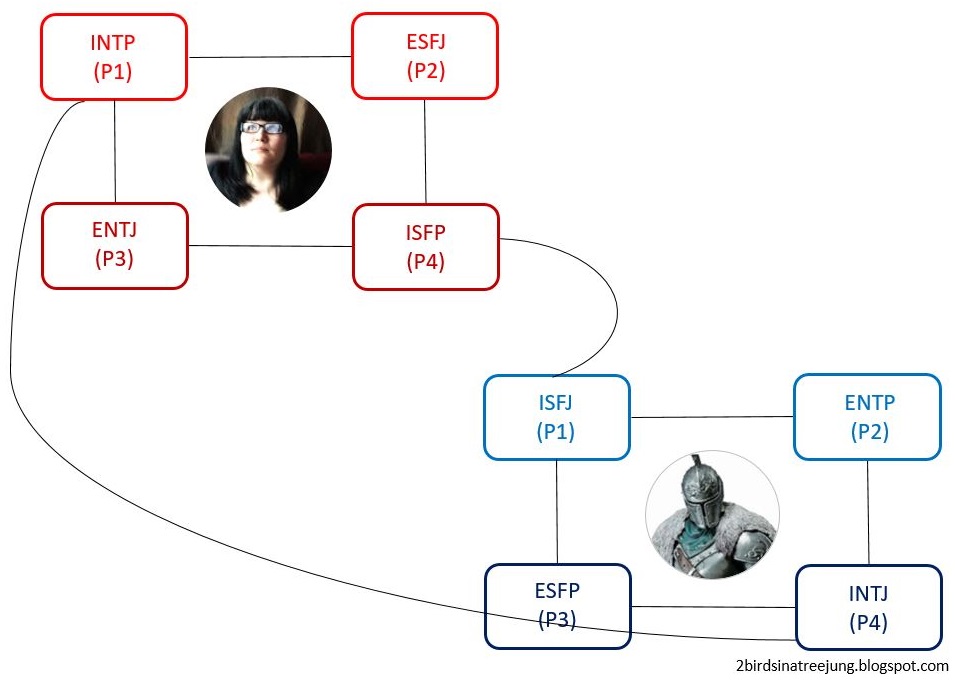
When you find out your (or someone else’s) type you only know part of the story… 1/4 of the story to be precise. What we commonly think of as our type is only that of one of the four inner personalities that exist within us. This is one reason why different individuals of the same type can be so different. 

For example, you can have an ESFJ who’s done some work and developed their opposite personality, INTP. Such an ESFJ is going to look very different from ESFJs who haven't developed their inner INTP, spending a lot of time reading and thinking and working very hard on their intellectual pursuits. They’re never going to be as good at being an INTP as an actual INTP - using ones' inferior function is always awkward and scary - but it will bring them far more meaning than it would for an actual INTP. The same holds for every type. The paradoxical truth is that our greatest weakness is actually our greatest strength. 

This is also why we sometimes find certain people irresistible, we project this internal “other” onto an appropriate target. For example healthy ESFJs, when they get to a certain level of development, will often find themselves mysteriously attracted to healthy INTPs. Think of the phrase “opposites attract,” this is why that can be the case.


The four inner personalities are basically two pairs of opposites, two couples, that can be thought of as the four pillars of a complete personality. The first two personalities, the lucid ego and animus, are easy to see as they are conscious. The second two personalities, however, are generally much harder to become aware of as they are repressed by the conscious personalities. If you flip a coin even though you may get heads, tails still exists, it’s just hidden from sight on the other side of the coin. The shadow animus and ego still exist, they're just hidden from sight on the other side of the coin so to speak.


(“S. Anima/us” and “S. Ego” are Shadow Anima/us and Shadow Ego respectively.) 

Saying that someone is an MBTI type is limiting... and incorrect. No one is just an ENTP, or an ESFP, or any other type. No two individuals of the same type are the same. First off, we're all shaped by a lifetime of experiences. We're shaped by the things that happened to us but, even more, by the choices we make, by how we choose to respond to those experiences. Do we take our experiences as opportunities to grow and deepen? Or do we hide from having to make those often difficult choices? Even deeper than all of that we have a profound individuality, along with our profound connection with each other and with the Universe. And finally, we're not just one type, we have all four types of our sodality within us. All four of the types that are in us are also us; who we are and how we relate to the world are the result of all of these four inner personalities, not just the one that's the most obvious. 


The core complexes  


The change of character brought about by the uprush of collective forces is amazing. A gentle and reasonable being can be transformed into a maniac or a savage beast. One is always inclined to lay the blame on external circumstances but nothing could explode in us if it had not been there. As a matter of fact, we are constantly living on the edge of a volcano, and there is, so far as we know, no way of protecting ourselves from a possible outburst that will destroy everybody within reach. It is certainly a good thing to preach reason and common sense, but what if you have a lunatic asylum for an audience or a crowd in a collective frenzy? There is not much difference between them because the madman and the mob are both moved by impersonal, overwhelming forces.
— Carl Jung


The four inner personalities can be summed up with the following descriptions:
  • The lucid (conscious) ego is what you, and others, think you are.
  • The lucid animus or anima is what you fear but at the same time wish you were.
  • The shadow (unconscious) animus or anima is the opposite of the lucid anima/us, it’s what you are good at but reject... or should reject.
  • The shadow ego is what you really are deep down but aren’t aware of.
Any one of these inner personalities can be active at any time, and this can change moment to moment. When a situation arises in which you need to access certain functions you'll spontaneously go into the complex that contains those functions. When that particular personality is unconscious, though, we usually end up expressing the more negative traits of that type. For example, ENTPs who find themselves in a situation where they need to be serious and hard-working often find themselves in their antagonistic shadow animus; in their case, they basically become really anxious INTJs. This changes when we develop the shadow complexes but until then, as is the case with all unconscious psychological contents, they only express their negative aspects.
 
What happens more commonly, however, is that we wind up spending most of our time on one or the other of the complexes as our homebase. If our homebase is our lucid ego we are stereotypical of that particular type. If it's the lucid anima/us, we balance our main type with strengths from our opposite type, even though we're not particularly skilled at it. If our homebase is the shadow anima/us, we're the worst expression of that type but in a very normal, average way. And the only time our homebase is the shadow ego is if we're in deep emotional distress, probably pathological. Or, conversely, we've reached the highest levels of spiritual development.


Personality 1: The Lucid Ego

Our sense of self. This is the hub that holds all the other complexes together in the wheel of consciousness. We become conscious of this complex first, which makes sense as it contains the easiest functions to develop. Made up of the hero the Hero/ine and the Parent functions. If all goes well we usually finish developing the ego complex by the end of our youth/young adult years. When someone says there a certain type they mean the ego complex.

This is usually the “homebase” of our conscious awareness though that’s not always the case; in fact, many people spend a lot more time in one of the other complexes. This is one major reason why some people are so hard to type. However, unless we’re being “possessed” by one of the complexes - unless consciousness has been seized by another complex - the ego complex still, even in this situation, seems to retains its control.
 
This complex is the foundation of the cultivated individual. Without it, no growth is possible. In order to bring unconscious contents into consciousness we need a strong ego. It’s the boat we carry the unconscious contents back to shore in. However, everything has a good and bad side and the ego is no different. We can get stuck here if we're only interested in power or advancement as the ego complex is our greatest strength. If we believe that it’s the most important thing, the only important thing, it can do great harm. One obvious way is when we think our needs and desires are more important than those of others. The ego can also think it’s more important than the other parts of the personality and refuse to do the work necessary to develop our other parts. The two are pretty much the same because if we are doing one we're doing the other.

The moral crux of this complex is: do we put it in its proper place, not as the master but as the servant of the Self? Or do we confuse it with the Self instead? All of our unreasonable, narcissistic desires to be the most beautiful, most popular, most successful, most wealthy, most powerful, what have you, are all, at root, our innate desire for the Self. The Self is the golden prize that these other things are symbols of.... and cheap replacements for. The supremacy of the ego is a very powerful illusion because the ego is, actually, a symbol of the Self brought into mundane reality; the Self is the original that the ego is a miniature, earthly copy of. This makes it easy to confuse the two.

The ego's purpose is to make the moral choice to do the work we should be doing. However, the things we have to work on — the things that come into our lives, or rise up out of us, that challenge us — that all comes from the Self, not the ego. The ego has to do the things that are the ego's responsibilities: making the moral choice to suffer crucifixion on the cross of our irreconcilable opposites, to attempt to surmount our insurmountable difficulties. In this way, rather of being an impediment, the ego complex becomes the decisive factor in one’s psychological and spiritual maturation.
The possession of complexes does not in itself signify neuroses… and the fact that they are painful is no proof of pathological disturbance. Suffering is not illness; it is the normal counterpole to happiness. A complex becomes pathological only when we think we have not got it.
- Jung, “Psychotherapy and a Philosophy of Life”

[Art by Yu Cheng Hong]


Personality 2: The Shadow Complex

The lucid animus; our contrasexual, or opposite gendered, inner other. If we identify as female this inner other is male, if male she’s female. It's the gateway to our personal unconscious. Integrating it gives us access to deeper levels of consciousness. I also call this the antipodal personality as it’s the opposite of the ego; the equal and opposite weakness of our greatest strength. If our greatest strength is intuition, it's our sensation weakness; if we're most comfortable in the outer world, it's introverted, etc. It’s made up of the Anima/us and Child functions. The shadow complex is initially terrifying partly because it is and always will be painful and embarrassing; no matter how much of it we bring into consciousness it will always be our Achilles’ heel. But it’s also because, when we begin this whole process, it contains everything that we are unconscious of.

When we first confront the shadow complex it is, as is typical of undifferentiated contents of the unconscious, mixed up with (“contaminated with”) everything else in the unconscious: the animus and anima, the enemy and the criminal, the inner witch and the inner brute. And since everything is unconscious it’s all wicked and unreformed. Jung describes our initial encounter with the shadow in this way:
The unconscious is commonly regarded as a sort of incapsulated fragment of our most personal and intimate life - something like what the bible calls the “heart” and considers the source of all evil thoughts. In the chambers of the heart dwell the wicked blood spirits, swift anger and sensual weakness. This is how the unconscious looks when seen from the conscious side. But consciousness appears to be essentially an affair of the cerebrum, which sees everything separately and in isolation, and therefore sees the unconscious in this way too, regarding it outright as my unconscious. Hence it is generally believed that anyone who descends into the unconscious gets into a suffocating atmosphere of egocentric subjectivity, and in this blind alley is exposed to the attack of all ferocious beasts which the caverns of the psychic underworld are supposed to harbour.
- Jung, The Archetypes and the Collective Unconscious

This is the first test, the gate that is guarded by Cerberus, the terrifying watchdog of the Underworld. It’s so terrifying that it generally scares off most people before they even start because, let’s face it, none of us want to see what we really look like. Most people shy away from this ugly, painful, and humiliating part of ourselves but until you gaze deeply into your own reflection, you will never pass through this gate. This is our first experience with the unconscious, the narrow door we call the shadow.

However, once we do pass our first test we find a whole world opening up before us, and what at first appeared to be sinister darkness reveals itself to actually be one of the brightest parts of our personality. This is a common experience when dealing with the unconscious; in truth, when we face the dragon and allow ourselves to fully experience our shame we find that this is one of the best parts of ourselves. And, if we continue this work, we will find that this is actually the easiest part of the process. All you have to do is endure your human imperfections. The hard work comes after dealing with the shadow.

The shadow complex isn’t actually that difficult to integrate. In fact, most people of even very average psychological health generally seem to manage it. There are many people who are neither neurotic nor particularly healthy who naturally and fairly easily integrate this complex. Many people of very average health “live” in the shadow complex but they do so in a very average way. These are the people who are generally comfortable and satisfied with their lives and see no need to reflect on it.

When they are unconscious, complexes are often unpleasant and unhealthy. However, the shadow complex, along with the ego complex, is actually in our conscious psyche; it’s the lucid, or bright, anima/us. So long as you don’t try to avoid it most normal people seem to develop this part of their psyche by mid-life. A healthy person, however, will express the healthiest qualities of their lucid anima/us, just as they do for every complex. The trick is getting there; when complex is being fully integrated it’s very painful and difficult, like giving birth to yourself.

“The most terrifying thing is to accept oneself completely.”
― Jung
 
In contrast to a neurotic person, or even someone who is of average psychological health, a healthy person will express the highest qualities of their shadow complex. For example, an ENFP who naturally, without any real effort, develops their ISTJ shadow complex will actually be quite practical and careful. However, an ENFP who has really developed their lucid anima/us — has suffered the torments of having to deal with all the excruciating, challenging, and boring mundanities of their ISTJ Shadow complex — such an ENFP will express the absolute highest and most noble traits of the ISTJ. They are trustworthy and loyal, servants of humanity, working tirelessly to make the world a better place without asking for anything in return. Even people with ISTJ as their ego complex won’t be as amazing, although their ability “to ISTJ” for long periods will, naturally, be more robust than even a very healthy ENFP.

Reforming our lucid anima/us requires that we do the hard work of confronting the darkness and accepting all of the unsightly, disagreeable, and, most of all, painfully excruciating parts of ourselves. We need to allow it to live with us, to embarrass and even torment us. It’s like the story of the princess who had to marry the frog; we must let the ugly frog sit next to us at dinner, to feed off our own plate. We need to marry this unsightly part of us, for when we do it finally reveals itself to be our handsome prince.

When we finally confront, then integrate, this part of ourselves we find that we are able to tap into something what, while weak and awkward, and will always be weak and awkward, is far more meaningful then our brawny ego complex could ever be. While the ego complex is the way we are productive and act effectively in the world, the shadow complex is what imbues our actions with beauty and nobility.
The meeting with oneself is, at first, the meeting with one’s own shadow. The shadow is a tight passage, a narrow door, whose painful constriction no one is spared who goes down to the deep well. But one must learn to know oneself in order to know who one is. For what comes after the door is, surprisingly enough, a boundless expanse full of unprecedented uncertainty, with apparently no inside and no outside, no above and no below, no here and no there, no mine and no thine, no good and no bad. It is a world of water, where all life floats in suspension; where the realm of the sympathetic system, the soul of everything living, begins; where I am indivisibly this and that; where I experience the other in myself and the other-than-myself experiences me.
- Jung, The Archetypes and the Collective Unconscious

[Image from Zerochan.net]


Personality 3: The Anima/us Complex

The shadow anima/us; the unconscious side of our anima/us; the dark half of our inner partner. This is, according to John Beebe, basically the obnoxious, unpleasant side of our animus or anima; where the lucid anima/us is the “nice guy/girl” the shadow anima/us is the “bad boy/girl.” It can be thought of as the antagonistic, mirror personality. It will have the opposite attitudes (introversion/extroversion) of the ego complex. For example; the ISFJ is made up of Si heroine and Fe parent. The type with Se hero and Fi parent, the opposite attitudes of ISFJ, would be the ESFP. So the shadow anima/us of ISFJ is ESFP, and vice versa.

After we’ve integrated the conscious lucid anima/us, the shadow complex, we start becoming aware of the unconscious shadow anima/us, the anima/us complex. This is the first of our two unconscious complexes and, as it’s unconscious, it’s far more difficult to integrate successfully then the shadow complex. We have a love/hate relationship with it where we are both attracted to and repulsed by it, as if we were in a volatile, roller coaster romance with a particularly vexing lover. The animus complex and is formed from the Nemesis and Critic functions.

The negative qualities expressed by one's unconscious shadow anima/us are one's very normal, every day negative qualities. This isn’t where we become evil and destroy the world, we’re just off putting. When we get into normal arguments - not severe ones, just your ordinary, every day disagreements - what is often happening is that one or both people are going into their shadow anima/us and, because it’s unconscious, expressing it’s less attractive qualities.

For example, let’s look at the ISFJ when their in their shadow animus; the ESFP. When an ISFJ is frustrated by physical reality they tend to get ragey, even violent. They will yell a lot and sometimes literally punch things that aren’t working right. Or an average-neurotic ESFJ will be selfish and childish, and make unreasonable demands on those they feel they can take advantage of, much like an unhealthy ISFP, their shadow anima/us. Or an INFP, instead of being connected with their powerful emotional core, will be shallow and concerned only with looking good to others when in their ENFJ shadow anima/us. When we go into our anima/us complex without consciousness we express it in a disagreeable way, as in our previous example of a ENTP worrying a lot and becoming anxious when they need to be practical and hard-working. Anxiety and worry are the negative side of their shadow anima/us, as raginess and destructiveness are part of the negative side of the ISFJ’s shadow anima/us.
 
In addition to dipping into our shadow anima/us when under pressure, we can also chronically stay in it in a very normal, relatively well adapted way, at least in the first half of life. Just like with those individuals who live in the lucid anima/us, this can make these individuals very difficult to type because they look more like their shadow animus than their ego, their “type”. In this situation the complex, even though relatively unconscious, isn’t really causing huge problems, at least not at this point in time.

Regardless of whether we go into the shadow anima/us temporarily or we habitually live there, when we're young it isn’t that big a deal. We are slightly unhealthy but still generally functional; just your normal, fallible, ordinary jerk. Maybe we’re a bit noxious but it’s nothing too disruptive. Others around us can usually see our flaws pretty clearly even though we ourselves willfully turn a blind eye to them. At this point we are barely on the cusp of neurosis but we are still functional; our unconsciousness may cause discord but it’s not ruining lives. But, as we age, unless we start growing we will become more and more neurotic as we find ourselves grappling with feelings of meaninglessness and stagnation. And, as long as we are unconscious of this part of us, there’s always a danger that we'll truly fall into serious neurosis. Living in this complex isn’t harmless.

Even people who live in the shadow animus in a generally not terrible way will constantly find themselves falling into the trap of acting out the shadow animus's worst traits. What is required by this complex, first and foremost, is that we stop blindly acting out. When we catch ourselves going into it in a negative, harmful way we need to stop. Take a deep breath. Feel your feelings, whatever they are; frustration, anxiety, impatience, envy, whatever it is that is currently possessing us. We need to stop and feel those feelings, and then we need to decide what to do with them. Are they really called for? Are they helpful? Are they moral? Are they right?

“One does not become enlightened by imagining figures of light, but by making the darkness conscious.”
― Jung

The first thing we need to do is actually admit that we are doing what we’re doing. The biggest problem with this complex is how invisible it is to us (though not to anyone else). Since we aren’t able to see our own disgraceful behavior we usually end up projecting it on to others. We feel so much shame for our innocent lucid anima/us but we can’t see how horribly our unconscious anima/us is behaving. If the moral crux of the ego complex is to submit to a greater authority, and the lucid anima/us is to face our fears, the moral crux of the shadow is to confess our faults. Take back the all the flaws we project on to everyone else around us and accept them back into us, where they belong. To take another step towards wholeness and integration.

One thing we need to remember about the animus complex is that it contains the critic function; this is the function that we turn cruelly and coldly on to others but ought to be aiming at ourselves. What is the thing we should be doing? Where are we failing? Whenever we find ourselves cruelly judging others with complete coldness and an utter lack of empathy we need to stop. Think. Remember. I do that too. In fact, I do that WORSE. I am the one that I should be judging.

The anima/us complex, like the ego complex, is strong. While we not as inexhaustible as the ego complex - if we use it too much we will eventually get tired - we can still use it far more than the other two complexes. It's very easy for us to fall into the trap of trying to live here, especially because it's the thing that we most want in the world. If the shadow complex is the thing we least want to do but must do, the anima/us complex is the thing we most want but must sacrifice in order to avoid neurosis. It's the sacrifice that our personal and spiritual growth requires from us. But it's not all austerity and sacrifice; if we manage to make the correct though heartbreaking choice here we finally face the final test, we come to the final gate: the wise old woman/man.

[Image from PicsArt]


Personality 4: The Wise Old Woman/Man Complex

The final mystery; our secret, shadow ego. I call this complex the wise old woman/man because it’s both demonic and wise. Like Baba Yaga it can devour us, cook us in it’s fire and eat us up. But it’s also the keeper of wisdom, and guide to Arcadia. We must be as subtle and wise as it is when dealing with it. While it initially only shows it’s demonic, destructive side, once we’ve done the excruciating and protracted work of bringing it into consciousness it reveals itself to be our angelic guide to the Self. P4 is made up of the daimon and trickster functions.

As the Daimon function is the nucleus of this complex they share many of the same traits: obscurity, extreme resistance to being brought into consciousness, the tendency to only express itself in the worst most destructive ways. It is intractable, irresistible, uncontrollable, unreasonable, and demented. Where P3 is horrible and obnoxious but in a very human and relatable way, the wise old woman/man complex is utterly demonic. When we are seized by this complex we lose all control of ourselves. When people commit crimes of passion, or when a mob commits monstrous atrocities, it’s this complex that’s to blame in almost every case.

P4 is rage and hate, it’s madness and destruction. It gets activated when we are hit in our P2 insecurities, which is part of the reason why it’s so important to bring that complex into a healthy relationship with the lucid ego. Marie-Louise von France wrote that it’s our own small, personal evil that gives Big Evil - the vast, inhuman darkness that’s the other half of God's goodness - entry into our hearts. This is why the work we’re doing here is so essential; by reclaiming our own, personal evil we prevent these hideous, Lovecraftian forces from possessing us.

“The madman and the mob are both moved by impersonal, overwhelming forces.
— Jung

Jung said that these things we are working with in the unconscious are real; they may not be physical, they may be ideas but they’re not “just” ideas. Ideas have consequences. These things have consequences. Barring the presence of sociopaths all atrocities are the result of these invisible forces in our psyches. And even with sociopaths, much of the harm they cause is enabled by those around them who have been blinded and hamstrung by their own weakness and evil. We allow Evil to flourish when we refuse to do the painful work of redeeming our own little evil.

But, if we can’t even see this part of ourselves how can we possibly work on it? This is a large part of the problem and, though I will go into more detail in my later post on working with the MBTI, I can give you the basic keys here. We become able to work on this complex by working on all the other complexes, especially the other gate complex, Personality 2; the lucid animus. Undergoing the torment of the lucid animus with consciousness changes what was fuel for the eruptions of P4 into a way to liberate the shadow ego from the darkness. Never totally or completely - this part of us will always be out of our control - but it will begin to show its angelic face.

It’s only by suffering the most excruciating pain of the most vulnerable part of us that we're able to redeem the demon and return her to her original state as angel. When we do so we free her to perform her holy task; where the lucid animus is our highest and most to noblest aspirations, the shadow ego is where we connect with God.

Personality 4 is the second gate we must pass through, after the first gate of Personality 2. P2 is the gateway to our personal unconscious; the way we access our shadow animus and shadow ego. P4, on the other hand, is our entry to even deeper levels of the unconscious, what Jung called the collective unconscious, where the Self resides. The shadow ego is our hidden personality, our eidolon (eye-DOH-len). The word comes from the Greek and means: double, phantom, ghost; image of an ideal; a shade or phantom look alike.[1] This is our invisible, other self.

There are many stories, across all cultures, of our lost twin; the doppelgänger that, when we encounter them, signals our fate. Fiction is also full of them. I refer to this other self in the very title of this blog, which comes from the following excerpt from Upsnishads:
Two birds, inseparable friends, cling to the same tree. One of them eats the sweet fruit, the other looks on without eating.

On the same tree a man sits grieving, immersed, bewildered by his own impotence. But when he sees the other is contented and knows his glory, then his grief passes away.

When the seer sees the brilliant maker and lord of the world as the Person who has his source in Brahman, then he is wise, and shaking off good and evil, he reaches the highest oneness, free from passions;

For he is the Breath shining forth in all beings, and he who understands this becomes truly wise, not a talker only. He revels in the Self, he delights in the Self, and having performed his works he rests, firmly established in Brahman, the best of those who know Brahman.
— The Upanishads

The bird who eats the fruit is the conscious ego, the ego complex. But we also have another I, another ego; the shadow ego. Our secret other self lives outside of life. We, our ego, eat the sweet fruit of life, but this other I - this hidden ego, our beloved friend and companion - watches without partaking. This other I doesn’t live in the world, she lives in the Unconscious, and as our lucid ego's job is to interact with outer objective reality, this other I’s job is to interact with inner subjective reality.

This is why this complex is the wise old woman; it isn’t because she’s old but because she is the ageless guide to the other world. In fact, she’s only really old when we're young. When we are young this transcendent personality is old, but when we grow old she grows young. She is the avatar of wisdom, the coniunctio, the marriage of our irreconcilable opposites: head and heart, body and soul. As our task with the shadow animus is to unhook him from the ego and connect him up with the lucid animus, his other half, so to here we must unhook the shadow ego from the lucid animus, break their dysfunctional marriage, and connect her back up with her other side, the lucid ego.

Redeeming the eidolon requires a lot of hard work and suffering. But, once we’ve started liberating her from the darkness we begin to want to express the creativity, love, wisdom, peace, and passion of the divine, to bring it into the world. We love to do this thing, whatever it is, but we never get good at it as it’s our greatest weakness. But that’s OK, because it’s purpose is not to gain wealth or acclaim but for a sacred purpose. When Jung, an INTP, created Bollingen he was creating a physical manifestation of his sacred work through his creative ISFP Shadow ego. A normal ISFP will do something similar but it will be mundane; it may be beautiful and expressive but it won’t be sacred. For us to express the sacred we need our inner wise woman/man.

Work on the shadow is one's “apprentice-piece,” the piece we create to graduate to becoming a master. Work on one’s animus or anima is one's “master-piece,” the work that shows the world that we are a master. But the work we do with our shadow ego, the inner wise woman or man, is our Magnum Opus; it’s the greatest, most beautiful, but most challenging work of our lives.

[Art by Rupid Leejm]


Working with the complexes

[Image from Jung's book Psychology and Alchemy]

A complex can be really overcome only if it is lived out to the full. In other words, if we are to develop further we have to draw to us and drink down to the very dregs what, because of our complexes, we have held at a distance.
- Jung, “Psychological Aspects of the Mother Archetype”


This is going to be a brief introduction to working with the complexes, more to give an idea of what it looks like then anything else. I will be going into more depth in future posts.

Each of the four inner personalities has a relationship with every other personality. Pay attention to your dreams, of course, to see when one of these figures shows up. Also pay attention to any fascinations you may have; libido - desire - is a strong indicator that the unconscious wants to go in a certain direction. Fascination is a form of desire, and attention a form of love; that which you love and value you spend a lot of time thinking about and working on. Someone who loves his garden will constantly be working on it, thinking about it, wondering if it’s OK, fantasizing what new flowers or vegetables he can plant. This work we are doing requires a lot of love, and libido gives us the stamina and motivation to stay the course.

The complexes can come to us from inside or outside. When we fall in love - really fall in love; madly, passionately, unreasonably fall in love - that’s the unconscious working. The unconscious has a special ability to reveal to us the numinous in the world. Without it, life is meaningless and dull. But when we have our relationship to it right, when it’s able to flow in our lives, life has color and savor. This is why, when we fall in love, the world is so much brighter. Or maybe you’re fascinated by a certain book, movie, or TV show. All those preteens and middle-aged women weren’t watching Twilight because it was such a well-made film, they were fascinated by the potent animus figures. When we develop a fascination for a thing or person, pay attention. Eventually you will see your projected complex hiding in them.

They can also come to us from inside. Learn what your various personalities feel like and keep an eye out for them. This is especially the case when you feel suddenly possessed by an affect or emotion; why did I suddenly get so ragey, or so sad? Any overreaction is a sign that complex has been touched. If somebody cuts you off and you get violently angry, that's probably a complex. Try as much as possible to stay present and aware when it happens. If you can’t don’t get discouraged; I still struggle with this and I’ve been working on this for decades. It’s actually supposed to be difficult. Like with physical exercise, if it’s not hard, it’s not working.

“Our suffering comes from our own unlived life – the unseen, unfelt parts of our psyche.”
— Jung

Use active imagination to get to know these inner figures when they make their appearance, whether from within or without. Just be sure that if you work with an outer figure (an actual person in your life) that you don’t try to influence that person; i.e. no black magic. If you try to influence the object of your passions - whether to make a beloved fall in love with you, or to hurt someone who’s hurt you - you will undermine everything that you’re trying to accomplish. Trying to force others, or the Unconscious, to your ego's will is only going make you even more unhealthy and neurotic by increasing, rather than decreasing, unconsciousness. The journey to wholeness requires us to make moral decisions, not to seek to fulfill our wishes but to strike out on an adventure, to answer a great calling.

Make sure you make it very clear to yourself that you are working with your own inner figure, not the other person. If you want to try using active imagination go here for more detailed information on how to do it, or, if you find yourself struggling, go to a Jungian analyst or another type of therapist or healer, preferably someone who is versed in this kind of thing, possibly someone with a spiritual background. Active imagination is basically the same spiritual practice of meditation that every religious tradition has used, for as long as we’ve been humans I imagine. It isn’t for everyone, though, so if it doesn’t work for you, or you just don’t want to do it, don’t worry about it, just focus on the practice of maintaining presence.

Probably the very best way to work with these inner figures, other than active imagination, is to pay extra attention to your romantic feelings. There’s a reason the core complexes so frequently appear in fiction as two romantically connected couples; like in our external relationships, desire and love is the thread that draws the opposites to each other. In every relationship different complexes will interact with each other. For example, despite the fact that my fiancé (“G”) is an ISFJ, and pretty much my opposite in every way, we get along swimmingly. This is because both of us have developed core complexes other than our ego complex; I am in touch with my affectionate, loving ESFJ side, and he’s in touch with his smart, playful, funny inner ENTP. But I believe the heart of our connection is due to our P4 secret egos and their relationship with each other (see below), at least that’s the case from my end.

I know that my inner ISFP calls the shots, even though I can almost never see her as she’s my hidden, other self. It’s her affection for G’s warmth and kindness that feeds my love for, and feelings of connection with, him.  One way I know this is that when we fight in such a way that her feelings are hurt, that connection is completely ruptured. For days. It’s really devastating to G and I hate to hurt him but I literally cannot help it, her feelings are either there or they’re not. She’s the one who loves his genial ISFJ personality, so when she’s sulking there’s not much my INTP ego can do about it.


The reverse is also true; when his vulnerable Ne anima function feels threatened his inner INTJ rises up in really cold, nasty, unrelated way. He becomes suspicious and unkind. When I ask him what I can do to make things better he says “I don’t know!” and, of course, he doesn't. When we are in this state and try to think of a way to make things better there’s almost a feeling of despair as we can’t see any way out.

When these kinds of situations arise we need to bring presence to them. We need to sit with our feelings. Maybe we need to bring our judging Critic function to this part of ourselves. Or maybe we need to soothe and nurture it, as we would a small child. When this happens it means that something in us is trying to get our attention. If we can just endure, if we can bring ourselves to just sit and stew in these unpleasant emotions, maintain our awareness, the solution usually presents itself. Jung said, “when you were up against a wall, put down roots like a tree, until clarity comes from deeper sources to see over the wall and grow.” This is what we must do; we have to center and ground ourselves, let our roots grow deep into the unconscious. The answer will come to us, we just need to give it time.

Any of our complexes can relate with any of another person's complexes. Paying attention to who’s doing what, why, and how - staying present and aware in the face of the natural chaos of our every day lives - is one of the most powerful ways to become conscious of, and eventually integrate, these inner figures.


Integrating the core complexes requires that we give them our time and attention, and that we be willing to suffer. Since we humans are fundamentally lazy this integration is pretty uncommon (Jung once said “laziness is the greatest passion of mankind, even greater than power or sex or anything.”)

This is the great moral question of all of our lives; do we suffer, and toil, as is asked of us? Or do we take the easy way out - the cheaters way out - and wind up a neurotic mess who makes the world a worse place? These things have consequences. Each of us have the capacity to become a powerful channel of healing, bringing clean, healthy waters from the unconscious to wash away all the garbage in our increasingly screwed up world. The world needs the curative powers of the healthy unconscious but that will only happen if more and more of us have the moral courage to turn away from what others (and even we ourselves) tell us is important. To turn inward, to find the treasure without compare, the golden prize: the Self.
Out of evil, much good has come to me. By keeping quiet, repressing nothing, remaining attentive, and by accepting reality - taking things as they are, and not as I wanted them to be - by doing all this, unusual knowledge has come to me, and unusual powers as well, such as I could never have imagined before.

I always thought that when we accepted things they overpowered us in some way or other. This turns out not to be true at all, and it is only by accepting them that one can assume an attitude towards them.

So now I intend to play the game of life, being receptive to whatever comes to me, good and bad, sun and shadow forever alternating, and, in this way, also accepting my own nature with its positive and negative sides. Thus everything becomes more alive to me.

What a fool I was! How I tried to force everything to go according to way I thought it ought to.
— Carl Jung, Alchemical Studies


MBTI

The cognitive functions
The function roles
The Houses
The core complexes
The Sodalities
How to type
Function + roles
My MBTI story


See also

Active imagination
Anima
Animus
Collective unconscious
Coniunctio
Contamination
Differentiation
Ego
Libido
Persona
Projection
Self
Shadow
Wise Old Woman/Man


Links

CS Joseph, “What are the four sides of the mind?
Daryl Sharp, Jung Lexicon
CG Jung, “ The narrow door of the shadow


References

[1]  Eidolon (Wikipedia)