Showing posts with label Marie Louise von Franz. Show all posts

Saturday, May 30, 2020

The sacred flame

Sacred Heart (Mexico)
[Image from StardustPrintShop (Etsy)]

At this point it becomes easier to understand why Jung always required of analysts that they should ultimately work the most on continuing to make progress in their own individuation. In doing so, they take their analysands along with them on their journey, without trying to influence them directly (which would be an abuse of power). In an early letter, Jung even goes so far as to say that the therapist should only analyze the pathological aspect of the patient’s psyche. This is because intellectual understanding is destructive. Understanding (Latin comprehendere), after all, means “taking hold of,” “grasping,” and this corresponds to an exercise of power. When the patients being and destiny are at stake, one should relate to his unique mystery with wordless respect. As Jung said, “we must understand the divine in us, but not in another in so far as he is capable of getting on and understanding on his own.” Our dreamer, as we will recall, was apprehensive about his encounter with patients. His dream points him back to working on himself
~ Marie-Louise von Franz, Psychotherapy

I thought about the secrets I had stored up inside my body. How many times I’ve crawled out my bedroom window to get in a car. The unstoppable fire between my legs. A fire not his. I thought about vodka. Nearly drowning. By the time he sat me on the couch to tell me I was his, I was miles away from daughter. A black suitcase making shape and story in my dreams. I felt like there was a muscle between us. The muscle was my sexuality. Not his.
~ Lidia Yuknavitch, The Chronology of Water


Welcome the madnesses, the stalemates, the gordian knots. Even though it's hard and painful, welcome these burdens. What you see as the Great Enemy who is trying to ruin all of your carefully laid plans is really your severe and demanding Guardian Angel, providing obstacles that will train your spiritual body into something strong and beautiful. Our madnesses are the Self trying to incarnate in us, God trying to come into the world.

The shaman is always a wounded healer. Those who can go into their own madness and come out of it whole are the only ones who are able to carry the weight of the Self into life. This is the important thing; your weakness is your strength. What is weak in outer, subjective reality is the yoke that links you with the Self. It is your way to bring the Self, or as much of it as you are able, into the world.

To understand boorishly and without care is to do violence to the soul. That desire in us - to know, to control, to make safe - diminishes that which is sacred into a “nothing but.” It turns what is glorious and beautiful and terrible into bland meaninglessness. Hindu’s greet each other with palm to palm, bowing as the God in them acknowledges the God in you. When we, or someone else, is experiencing madness, we put our hands together wordlessly, reverently, bow to this holy presence that is trying to come into the world. It’s not the places where we’re strong that matter, but where we are embarrassing, unpleasant, and inconvenient.

What is needed is a reverent attitude toward life, toward ourselves as well as others, toward all of existence. An open-hearted and open-minded attitude, an attitude of sympathy and compassion when we're in the thick of the struggle. Not everything needs to be known, or judged.... measured, or fit into “it's place.” Reverence stops us from harming ourselves and each other with our drive to put everything into safe little boxes. The thing in us which is bigger than the universe cannot be fit into a small, neat little box. By freeing our hearts and our minds we remember the Sacred that lives in and through us all.

The thing in us which is ours is ours. The thing in others which is theirs is theirs. We can - and should - clash and disagree, fight and struggle. But, at the same time, we must most of all always recognize and honor the Sacred that is laboring to birth itself into the world.


Friday, March 6, 2020

MBTI: The Core Complexes

Homer & Marge Simspson, and Ned & Maude Flanders

[Image from Giphy]

Everyone knows nowadays that people “have complexes.” What is not so well known, though far more important theoretically, is that complexes can have us.
— Jung


When you find out your (or someone else’s) type you only know part of the story… 1/4 of the story to be precise. What we commonly think of as our type is only that of one of the four inner personalities that exist within us. This is one reason why different individuals of the same type can be so different. 

For example, you can have an ESFJ who’s done some work and developed their opposite personality, INTP. Such an ESFJ is going to look very different from ESFJs who haven't developed their inner INTP, spending a lot of time reading and thinking and working very hard on their intellectual pursuits. They’re never going to be as good at being an INTP as an actual INTP - using ones' inferior function is always awkward and scary - but it will bring them far more meaning than it would for an actual INTP. The same holds for every type. The paradoxical truth is that our greatest weakness is actually our greatest strength. 

This is also why we sometimes find certain people irresistible, we project this internal “other” onto an appropriate target. For example healthy ESFJs, when they get to a certain level of development, will often find themselves mysteriously attracted to healthy INTPs. Think of the phrase “opposites attract,” this is why that can be the case.


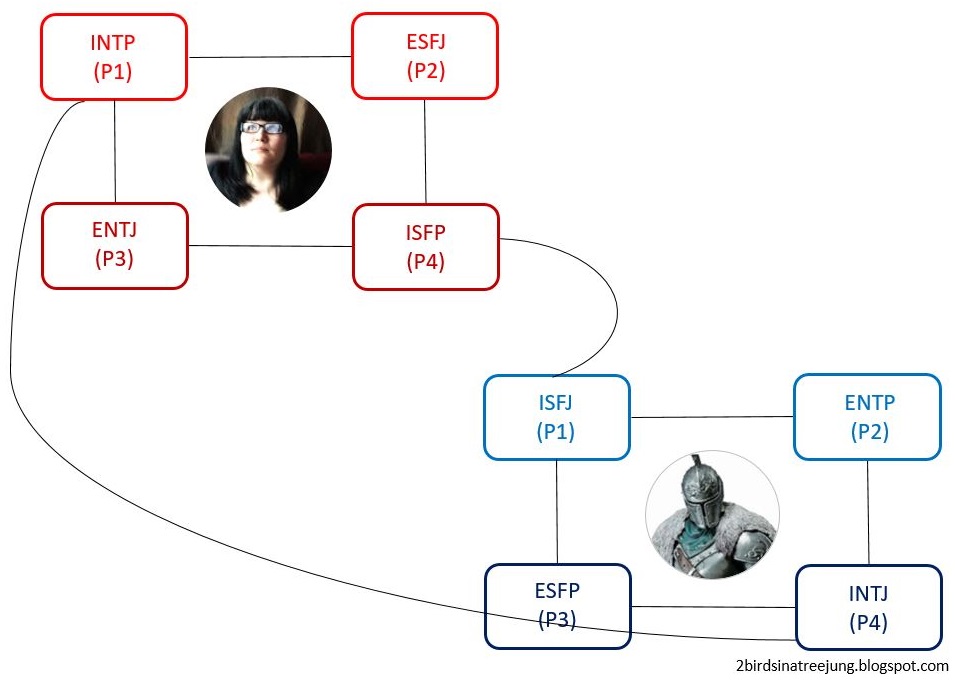
The four inner personalities are basically two pairs of opposites, two couples, that can be thought of as the four pillars of a complete personality. The first two personalities, the lucid ego and animus, are easy to see as they are conscious. The second two personalities, however, are generally much harder to become aware of as they are repressed by the conscious personalities. If you flip a coin even though you may get heads, tails still exists, it’s just hidden from sight on the other side of the coin. The shadow animus and ego still exist, they're just hidden from sight on the other side of the coin so to speak.


(“S. Anima/us” and “S. Ego” are Shadow Anima/us and Shadow Ego respectively.) 

Saying that someone is an MBTI type is limiting... and incorrect. No one is just an ENTP, or an ESFP, or any other type. No two individuals of the same type are the same. First off, we're all shaped by a lifetime of experiences. We're shaped by the things that happened to us but, even more, by the choices we make, by how we choose to respond to those experiences. Do we take our experiences as opportunities to grow and deepen? Or do we hide from having to make those often difficult choices? Even deeper than all of that we have a profound individuality, along with our profound connection with each other and with the Universe. And finally, we're not just one type, we have all four types of our sodality within us. All four of the types that are in us are also us; who we are and how we relate to the world are the result of all of these four inner personalities, not just the one that's the most obvious. 


The core complexes  


The change of character brought about by the uprush of collective forces is amazing. A gentle and reasonable being can be transformed into a maniac or a savage beast. One is always inclined to lay the blame on external circumstances but nothing could explode in us if it had not been there. As a matter of fact, we are constantly living on the edge of a volcano, and there is, so far as we know, no way of protecting ourselves from a possible outburst that will destroy everybody within reach. It is certainly a good thing to preach reason and common sense, but what if you have a lunatic asylum for an audience or a crowd in a collective frenzy? There is not much difference between them because the madman and the mob are both moved by impersonal, overwhelming forces.
— Carl Jung


The four inner personalities can be summed up with the following descriptions:
  • The lucid (conscious) ego is what you, and others, think you are.
  • The lucid animus or anima is what you fear but at the same time wish you were.
  • The shadow (unconscious) animus or anima is the opposite of the lucid anima/us, it’s what you are good at but reject... or should reject.
  • The shadow ego is what you really are deep down but aren’t aware of.
Any one of these inner personalities can be active at any time, and this can change moment to moment. When a situation arises in which you need to access certain functions you'll spontaneously go into the complex that contains those functions. When that particular personality is unconscious, though, we usually end up expressing the more negative traits of that type. For example, ENTPs who find themselves in a situation where they need to be serious and hard-working often find themselves in their antagonistic shadow animus; in their case, they basically become really anxious INTJs. This changes when we develop the shadow complexes but until then, as is the case with all unconscious psychological contents, they only express their negative aspects.
 
What happens more commonly, however, is that we wind up spending most of our time on one or the other of the complexes as our homebase. If our homebase is our lucid ego we are stereotypical of that particular type. If it's the lucid anima/us, we balance our main type with strengths from our opposite type, even though we're not particularly skilled at it. If our homebase is the shadow anima/us, we're the worst expression of that type but in a very normal, average way. And the only time our homebase is the shadow ego is if we're in deep emotional distress, probably pathological. Or, conversely, we've reached the highest levels of spiritual development.


Personality 1: The Lucid Ego

Our sense of self. This is the hub that holds all the other complexes together in the wheel of consciousness. We become conscious of this complex first, which makes sense as it contains the easiest functions to develop. Made up of the hero the Hero/ine and the Parent functions. If all goes well we usually finish developing the ego complex by the end of our youth/young adult years. When someone says there a certain type they mean the ego complex.

This is usually the “homebase” of our conscious awareness though that’s not always the case; in fact, many people spend a lot more time in one of the other complexes. This is one major reason why some people are so hard to type. However, unless we’re being “possessed” by one of the complexes - unless consciousness has been seized by another complex - the ego complex still, even in this situation, seems to retains its control.
 
This complex is the foundation of the cultivated individual. Without it, no growth is possible. In order to bring unconscious contents into consciousness we need a strong ego. It’s the boat we carry the unconscious contents back to shore in. However, everything has a good and bad side and the ego is no different. We can get stuck here if we're only interested in power or advancement as the ego complex is our greatest strength. If we believe that it’s the most important thing, the only important thing, it can do great harm. One obvious way is when we think our needs and desires are more important than those of others. The ego can also think it’s more important than the other parts of the personality and refuse to do the work necessary to develop our other parts. The two are pretty much the same because if we are doing one we're doing the other.

The moral crux of this complex is: do we put it in its proper place, not as the master but as the servant of the Self? Or do we confuse it with the Self instead? All of our unreasonable, narcissistic desires to be the most beautiful, most popular, most successful, most wealthy, most powerful, what have you, are all, at root, our innate desire for the Self. The Self is the golden prize that these other things are symbols of.... and cheap replacements for. The supremacy of the ego is a very powerful illusion because the ego is, actually, a symbol of the Self brought into mundane reality; the Self is the original that the ego is a miniature, earthly copy of. This makes it easy to confuse the two.

The ego's purpose is to make the moral choice to do the work we should be doing. However, the things we have to work on — the things that come into our lives, or rise up out of us, that challenge us — that all comes from the Self, not the ego. The ego has to do the things that are the ego's responsibilities: making the moral choice to suffer crucifixion on the cross of our irreconcilable opposites, to attempt to surmount our insurmountable difficulties. In this way, rather of being an impediment, the ego complex becomes the decisive factor in one’s psychological and spiritual maturation.
The possession of complexes does not in itself signify neuroses… and the fact that they are painful is no proof of pathological disturbance. Suffering is not illness; it is the normal counterpole to happiness. A complex becomes pathological only when we think we have not got it.
- Jung, “Psychotherapy and a Philosophy of Life”

[Art by Yu Cheng Hong]


Personality 2: The Shadow Complex

The lucid animus; our contrasexual, or opposite gendered, inner other. If we identify as female this inner other is male, if male she’s female. It's the gateway to our personal unconscious. Integrating it gives us access to deeper levels of consciousness. I also call this the antipodal personality as it’s the opposite of the ego; the equal and opposite weakness of our greatest strength. If our greatest strength is intuition, it's our sensation weakness; if we're most comfortable in the outer world, it's introverted, etc. It’s made up of the Anima/us and Child functions. The shadow complex is initially terrifying partly because it is and always will be painful and embarrassing; no matter how much of it we bring into consciousness it will always be our Achilles’ heel. But it’s also because, when we begin this whole process, it contains everything that we are unconscious of.

When we first confront the shadow complex it is, as is typical of undifferentiated contents of the unconscious, mixed up with (“contaminated with”) everything else in the unconscious: the animus and anima, the enemy and the criminal, the inner witch and the inner brute. And since everything is unconscious it’s all wicked and unreformed. Jung describes our initial encounter with the shadow in this way:
The unconscious is commonly regarded as a sort of incapsulated fragment of our most personal and intimate life - something like what the bible calls the “heart” and considers the source of all evil thoughts. In the chambers of the heart dwell the wicked blood spirits, swift anger and sensual weakness. This is how the unconscious looks when seen from the conscious side. But consciousness appears to be essentially an affair of the cerebrum, which sees everything separately and in isolation, and therefore sees the unconscious in this way too, regarding it outright as my unconscious. Hence it is generally believed that anyone who descends into the unconscious gets into a suffocating atmosphere of egocentric subjectivity, and in this blind alley is exposed to the attack of all ferocious beasts which the caverns of the psychic underworld are supposed to harbour.
- Jung, The Archetypes and the Collective Unconscious

This is the first test, the gate that is guarded by Cerberus, the terrifying watchdog of the Underworld. It’s so terrifying that it generally scares off most people before they even start because, let’s face it, none of us want to see what we really look like. Most people shy away from this ugly, painful, and humiliating part of ourselves but until you gaze deeply into your own reflection, you will never pass through this gate. This is our first experience with the unconscious, the narrow door we call the shadow.

However, once we do pass our first test we find a whole world opening up before us, and what at first appeared to be sinister darkness reveals itself to actually be one of the brightest parts of our personality. This is a common experience when dealing with the unconscious; in truth, when we face the dragon and allow ourselves to fully experience our shame we find that this is one of the best parts of ourselves. And, if we continue this work, we will find that this is actually the easiest part of the process. All you have to do is endure your human imperfections. The hard work comes after dealing with the shadow.

The shadow complex isn’t actually that difficult to integrate. In fact, most people of even very average psychological health generally seem to manage it. There are many people who are neither neurotic nor particularly healthy who naturally and fairly easily integrate this complex. Many people of very average health “live” in the shadow complex but they do so in a very average way. These are the people who are generally comfortable and satisfied with their lives and see no need to reflect on it.

When they are unconscious, complexes are often unpleasant and unhealthy. However, the shadow complex, along with the ego complex, is actually in our conscious psyche; it’s the lucid, or bright, anima/us. So long as you don’t try to avoid it most normal people seem to develop this part of their psyche by mid-life. A healthy person, however, will express the healthiest qualities of their lucid anima/us, just as they do for every complex. The trick is getting there; when complex is being fully integrated it’s very painful and difficult, like giving birth to yourself.

“The most terrifying thing is to accept oneself completely.”
― Jung
 
In contrast to a neurotic person, or even someone who is of average psychological health, a healthy person will express the highest qualities of their shadow complex. For example, an ENFP who naturally, without any real effort, develops their ISTJ shadow complex will actually be quite practical and careful. However, an ENFP who has really developed their lucid anima/us — has suffered the torments of having to deal with all the excruciating, challenging, and boring mundanities of their ISTJ Shadow complex — such an ENFP will express the absolute highest and most noble traits of the ISTJ. They are trustworthy and loyal, servants of humanity, working tirelessly to make the world a better place without asking for anything in return. Even people with ISTJ as their ego complex won’t be as amazing, although their ability “to ISTJ” for long periods will, naturally, be more robust than even a very healthy ENFP.

Reforming our lucid anima/us requires that we do the hard work of confronting the darkness and accepting all of the unsightly, disagreeable, and, most of all, painfully excruciating parts of ourselves. We need to allow it to live with us, to embarrass and even torment us. It’s like the story of the princess who had to marry the frog; we must let the ugly frog sit next to us at dinner, to feed off our own plate. We need to marry this unsightly part of us, for when we do it finally reveals itself to be our handsome prince.

When we finally confront, then integrate, this part of ourselves we find that we are able to tap into something what, while weak and awkward, and will always be weak and awkward, is far more meaningful then our brawny ego complex could ever be. While the ego complex is the way we are productive and act effectively in the world, the shadow complex is what imbues our actions with beauty and nobility.
The meeting with oneself is, at first, the meeting with one’s own shadow. The shadow is a tight passage, a narrow door, whose painful constriction no one is spared who goes down to the deep well. But one must learn to know oneself in order to know who one is. For what comes after the door is, surprisingly enough, a boundless expanse full of unprecedented uncertainty, with apparently no inside and no outside, no above and no below, no here and no there, no mine and no thine, no good and no bad. It is a world of water, where all life floats in suspension; where the realm of the sympathetic system, the soul of everything living, begins; where I am indivisibly this and that; where I experience the other in myself and the other-than-myself experiences me.
- Jung, The Archetypes and the Collective Unconscious

[Image from Zerochan.net]


Personality 3: The Anima/us Complex

The shadow anima/us; the unconscious side of our anima/us; the dark half of our inner partner. This is, according to John Beebe, basically the obnoxious, unpleasant side of our animus or anima; where the lucid anima/us is the “nice guy/girl” the shadow anima/us is the “bad boy/girl.” It can be thought of as the antagonistic, mirror personality. It will have the opposite attitudes (introversion/extroversion) of the ego complex. For example; the ISFJ is made up of Si heroine and Fe parent. The type with Se hero and Fi parent, the opposite attitudes of ISFJ, would be the ESFP. So the shadow anima/us of ISFJ is ESFP, and vice versa.

After we’ve integrated the conscious lucid anima/us, the shadow complex, we start becoming aware of the unconscious shadow anima/us, the anima/us complex. This is the first of our two unconscious complexes and, as it’s unconscious, it’s far more difficult to integrate successfully then the shadow complex. We have a love/hate relationship with it where we are both attracted to and repulsed by it, as if we were in a volatile, roller coaster romance with a particularly vexing lover. The animus complex and is formed from the Nemesis and Critic functions.

The negative qualities expressed by one's unconscious shadow anima/us are one's very normal, every day negative qualities. This isn’t where we become evil and destroy the world, we’re just off putting. When we get into normal arguments - not severe ones, just your ordinary, every day disagreements - what is often happening is that one or both people are going into their shadow anima/us and, because it’s unconscious, expressing it’s less attractive qualities.

For example, let’s look at the ISFJ when their in their shadow animus; the ESFP. When an ISFJ is frustrated by physical reality they tend to get ragey, even violent. They will yell a lot and sometimes literally punch things that aren’t working right. Or an average-neurotic ESFJ will be selfish and childish, and make unreasonable demands on those they feel they can take advantage of, much like an unhealthy ISFP, their shadow anima/us. Or an INFP, instead of being connected with their powerful emotional core, will be shallow and concerned only with looking good to others when in their ENFJ shadow anima/us. When we go into our anima/us complex without consciousness we express it in a disagreeable way, as in our previous example of a ENTP worrying a lot and becoming anxious when they need to be practical and hard-working. Anxiety and worry are the negative side of their shadow anima/us, as raginess and destructiveness are part of the negative side of the ISFJ’s shadow anima/us.
 
In addition to dipping into our shadow anima/us when under pressure, we can also chronically stay in it in a very normal, relatively well adapted way, at least in the first half of life. Just like with those individuals who live in the lucid anima/us, this can make these individuals very difficult to type because they look more like their shadow animus than their ego, their “type”. In this situation the complex, even though relatively unconscious, isn’t really causing huge problems, at least not at this point in time.

Regardless of whether we go into the shadow anima/us temporarily or we habitually live there, when we're young it isn’t that big a deal. We are slightly unhealthy but still generally functional; just your normal, fallible, ordinary jerk. Maybe we’re a bit noxious but it’s nothing too disruptive. Others around us can usually see our flaws pretty clearly even though we ourselves willfully turn a blind eye to them. At this point we are barely on the cusp of neurosis but we are still functional; our unconsciousness may cause discord but it’s not ruining lives. But, as we age, unless we start growing we will become more and more neurotic as we find ourselves grappling with feelings of meaninglessness and stagnation. And, as long as we are unconscious of this part of us, there’s always a danger that we'll truly fall into serious neurosis. Living in this complex isn’t harmless.

Even people who live in the shadow animus in a generally not terrible way will constantly find themselves falling into the trap of acting out the shadow animus's worst traits. What is required by this complex, first and foremost, is that we stop blindly acting out. When we catch ourselves going into it in a negative, harmful way we need to stop. Take a deep breath. Feel your feelings, whatever they are; frustration, anxiety, impatience, envy, whatever it is that is currently possessing us. We need to stop and feel those feelings, and then we need to decide what to do with them. Are they really called for? Are they helpful? Are they moral? Are they right?

“One does not become enlightened by imagining figures of light, but by making the darkness conscious.”
― Jung

The first thing we need to do is actually admit that we are doing what we’re doing. The biggest problem with this complex is how invisible it is to us (though not to anyone else). Since we aren’t able to see our own disgraceful behavior we usually end up projecting it on to others. We feel so much shame for our innocent lucid anima/us but we can’t see how horribly our unconscious anima/us is behaving. If the moral crux of the ego complex is to submit to a greater authority, and the lucid anima/us is to face our fears, the moral crux of the shadow is to confess our faults. Take back the all the flaws we project on to everyone else around us and accept them back into us, where they belong. To take another step towards wholeness and integration.

One thing we need to remember about the animus complex is that it contains the critic function; this is the function that we turn cruelly and coldly on to others but ought to be aiming at ourselves. What is the thing we should be doing? Where are we failing? Whenever we find ourselves cruelly judging others with complete coldness and an utter lack of empathy we need to stop. Think. Remember. I do that too. In fact, I do that WORSE. I am the one that I should be judging.

The anima/us complex, like the ego complex, is strong. While we not as inexhaustible as the ego complex - if we use it too much we will eventually get tired - we can still use it far more than the other two complexes. It's very easy for us to fall into the trap of trying to live here, especially because it's the thing that we most want in the world. If the shadow complex is the thing we least want to do but must do, the anima/us complex is the thing we most want but must sacrifice in order to avoid neurosis. It's the sacrifice that our personal and spiritual growth requires from us. But it's not all austerity and sacrifice; if we manage to make the correct though heartbreaking choice here we finally face the final test, we come to the final gate: the wise old woman/man.

[Image from PicsArt]


Personality 4: The Wise Old Woman/Man Complex

The final mystery; our secret, shadow ego. I call this complex the wise old woman/man because it’s both demonic and wise. Like Baba Yaga it can devour us, cook us in it’s fire and eat us up. But it’s also the keeper of wisdom, and guide to Arcadia. We must be as subtle and wise as it is when dealing with it. While it initially only shows it’s demonic, destructive side, once we’ve done the excruciating and protracted work of bringing it into consciousness it reveals itself to be our angelic guide to the Self. P4 is made up of the daimon and trickster functions.

As the Daimon function is the nucleus of this complex they share many of the same traits: obscurity, extreme resistance to being brought into consciousness, the tendency to only express itself in the worst most destructive ways. It is intractable, irresistible, uncontrollable, unreasonable, and demented. Where P3 is horrible and obnoxious but in a very human and relatable way, the wise old woman/man complex is utterly demonic. When we are seized by this complex we lose all control of ourselves. When people commit crimes of passion, or when a mob commits monstrous atrocities, it’s this complex that’s to blame in almost every case.

P4 is rage and hate, it’s madness and destruction. It gets activated when we are hit in our P2 insecurities, which is part of the reason why it’s so important to bring that complex into a healthy relationship with the lucid ego. Marie-Louise von France wrote that it’s our own small, personal evil that gives Big Evil - the vast, inhuman darkness that’s the other half of God's goodness - entry into our hearts. This is why the work we’re doing here is so essential; by reclaiming our own, personal evil we prevent these hideous, Lovecraftian forces from possessing us.

“The madman and the mob are both moved by impersonal, overwhelming forces.
— Jung

Jung said that these things we are working with in the unconscious are real; they may not be physical, they may be ideas but they’re not “just” ideas. Ideas have consequences. These things have consequences. Barring the presence of sociopaths all atrocities are the result of these invisible forces in our psyches. And even with sociopaths, much of the harm they cause is enabled by those around them who have been blinded and hamstrung by their own weakness and evil. We allow Evil to flourish when we refuse to do the painful work of redeeming our own little evil.

But, if we can’t even see this part of ourselves how can we possibly work on it? This is a large part of the problem and, though I will go into more detail in my later post on working with the MBTI, I can give you the basic keys here. We become able to work on this complex by working on all the other complexes, especially the other gate complex, Personality 2; the lucid animus. Undergoing the torment of the lucid animus with consciousness changes what was fuel for the eruptions of P4 into a way to liberate the shadow ego from the darkness. Never totally or completely - this part of us will always be out of our control - but it will begin to show its angelic face.

It’s only by suffering the most excruciating pain of the most vulnerable part of us that we're able to redeem the demon and return her to her original state as angel. When we do so we free her to perform her holy task; where the lucid animus is our highest and most to noblest aspirations, the shadow ego is where we connect with God.

Personality 4 is the second gate we must pass through, after the first gate of Personality 2. P2 is the gateway to our personal unconscious; the way we access our shadow animus and shadow ego. P4, on the other hand, is our entry to even deeper levels of the unconscious, what Jung called the collective unconscious, where the Self resides. The shadow ego is our hidden personality, our eidolon (eye-DOH-len). The word comes from the Greek and means: double, phantom, ghost; image of an ideal; a shade or phantom look alike.[1] This is our invisible, other self.

There are many stories, across all cultures, of our lost twin; the doppelgänger that, when we encounter them, signals our fate. Fiction is also full of them. I refer to this other self in the very title of this blog, which comes from the following excerpt from Upsnishads:
Two birds, inseparable friends, cling to the same tree. One of them eats the sweet fruit, the other looks on without eating.

On the same tree a man sits grieving, immersed, bewildered by his own impotence. But when he sees the other is contented and knows his glory, then his grief passes away.

When the seer sees the brilliant maker and lord of the world as the Person who has his source in Brahman, then he is wise, and shaking off good and evil, he reaches the highest oneness, free from passions;

For he is the Breath shining forth in all beings, and he who understands this becomes truly wise, not a talker only. He revels in the Self, he delights in the Self, and having performed his works he rests, firmly established in Brahman, the best of those who know Brahman.
— The Upanishads

The bird who eats the fruit is the conscious ego, the ego complex. But we also have another I, another ego; the shadow ego. Our secret other self lives outside of life. We, our ego, eat the sweet fruit of life, but this other I - this hidden ego, our beloved friend and companion - watches without partaking. This other I doesn’t live in the world, she lives in the Unconscious, and as our lucid ego's job is to interact with outer objective reality, this other I’s job is to interact with inner subjective reality.

This is why this complex is the wise old woman; it isn’t because she’s old but because she is the ageless guide to the other world. In fact, she’s only really old when we're young. When we are young this transcendent personality is old, but when we grow old she grows young. She is the avatar of wisdom, the coniunctio, the marriage of our irreconcilable opposites: head and heart, body and soul. As our task with the shadow animus is to unhook him from the ego and connect him up with the lucid animus, his other half, so to here we must unhook the shadow ego from the lucid animus, break their dysfunctional marriage, and connect her back up with her other side, the lucid ego.

Redeeming the eidolon requires a lot of hard work and suffering. But, once we’ve started liberating her from the darkness we begin to want to express the creativity, love, wisdom, peace, and passion of the divine, to bring it into the world. We love to do this thing, whatever it is, but we never get good at it as it’s our greatest weakness. But that’s OK, because it’s purpose is not to gain wealth or acclaim but for a sacred purpose. When Jung, an INTP, created Bollingen he was creating a physical manifestation of his sacred work through his creative ISFP Shadow ego. A normal ISFP will do something similar but it will be mundane; it may be beautiful and expressive but it won’t be sacred. For us to express the sacred we need our inner wise woman/man.

Work on the shadow is one's “apprentice-piece,” the piece we create to graduate to becoming a master. Work on one’s animus or anima is one's “master-piece,” the work that shows the world that we are a master. But the work we do with our shadow ego, the inner wise woman or man, is our Magnum Opus; it’s the greatest, most beautiful, but most challenging work of our lives.

[Art by Rupid Leejm]


Working with the complexes

[Image from Jung's book Psychology and Alchemy]

A complex can be really overcome only if it is lived out to the full. In other words, if we are to develop further we have to draw to us and drink down to the very dregs what, because of our complexes, we have held at a distance.
- Jung, “Psychological Aspects of the Mother Archetype”


This is going to be a brief introduction to working with the complexes, more to give an idea of what it looks like then anything else. I will be going into more depth in future posts.

Each of the four inner personalities has a relationship with every other personality. Pay attention to your dreams, of course, to see when one of these figures shows up. Also pay attention to any fascinations you may have; libido - desire - is a strong indicator that the unconscious wants to go in a certain direction. Fascination is a form of desire, and attention a form of love; that which you love and value you spend a lot of time thinking about and working on. Someone who loves his garden will constantly be working on it, thinking about it, wondering if it’s OK, fantasizing what new flowers or vegetables he can plant. This work we are doing requires a lot of love, and libido gives us the stamina and motivation to stay the course.

The complexes can come to us from inside or outside. When we fall in love - really fall in love; madly, passionately, unreasonably fall in love - that’s the unconscious working. The unconscious has a special ability to reveal to us the numinous in the world. Without it, life is meaningless and dull. But when we have our relationship to it right, when it’s able to flow in our lives, life has color and savor. This is why, when we fall in love, the world is so much brighter. Or maybe you’re fascinated by a certain book, movie, or TV show. All those preteens and middle-aged women weren’t watching Twilight because it was such a well-made film, they were fascinated by the potent animus figures. When we develop a fascination for a thing or person, pay attention. Eventually you will see your projected complex hiding in them.

They can also come to us from inside. Learn what your various personalities feel like and keep an eye out for them. This is especially the case when you feel suddenly possessed by an affect or emotion; why did I suddenly get so ragey, or so sad? Any overreaction is a sign that complex has been touched. If somebody cuts you off and you get violently angry, that's probably a complex. Try as much as possible to stay present and aware when it happens. If you can’t don’t get discouraged; I still struggle with this and I’ve been working on this for decades. It’s actually supposed to be difficult. Like with physical exercise, if it’s not hard, it’s not working.

“Our suffering comes from our own unlived life – the unseen, unfelt parts of our psyche.”
— Jung

Use active imagination to get to know these inner figures when they make their appearance, whether from within or without. Just be sure that if you work with an outer figure (an actual person in your life) that you don’t try to influence that person; i.e. no black magic. If you try to influence the object of your passions - whether to make a beloved fall in love with you, or to hurt someone who’s hurt you - you will undermine everything that you’re trying to accomplish. Trying to force others, or the Unconscious, to your ego's will is only going make you even more unhealthy and neurotic by increasing, rather than decreasing, unconsciousness. The journey to wholeness requires us to make moral decisions, not to seek to fulfill our wishes but to strike out on an adventure, to answer a great calling.

Make sure you make it very clear to yourself that you are working with your own inner figure, not the other person. If you want to try using active imagination go here for more detailed information on how to do it, or, if you find yourself struggling, go to a Jungian analyst or another type of therapist or healer, preferably someone who is versed in this kind of thing, possibly someone with a spiritual background. Active imagination is basically the same spiritual practice of meditation that every religious tradition has used, for as long as we’ve been humans I imagine. It isn’t for everyone, though, so if it doesn’t work for you, or you just don’t want to do it, don’t worry about it, just focus on the practice of maintaining presence.

Probably the very best way to work with these inner figures, other than active imagination, is to pay extra attention to your romantic feelings. There’s a reason the core complexes so frequently appear in fiction as two romantically connected couples; like in our external relationships, desire and love is the thread that draws the opposites to each other. In every relationship different complexes will interact with each other. For example, despite the fact that my fiancé (“G”) is an ISFJ, and pretty much my opposite in every way, we get along swimmingly. This is because both of us have developed core complexes other than our ego complex; I am in touch with my affectionate, loving ESFJ side, and he’s in touch with his smart, playful, funny inner ENTP. But I believe the heart of our connection is due to our P4 secret egos and their relationship with each other (see below), at least that’s the case from my end.

I know that my inner ISFP calls the shots, even though I can almost never see her as she’s my hidden, other self. It’s her affection for G’s warmth and kindness that feeds my love for, and feelings of connection with, him.  One way I know this is that when we fight in such a way that her feelings are hurt, that connection is completely ruptured. For days. It’s really devastating to G and I hate to hurt him but I literally cannot help it, her feelings are either there or they’re not. She’s the one who loves his genial ISFJ personality, so when she’s sulking there’s not much my INTP ego can do about it.


The reverse is also true; when his vulnerable Ne anima function feels threatened his inner INTJ rises up in really cold, nasty, unrelated way. He becomes suspicious and unkind. When I ask him what I can do to make things better he says “I don’t know!” and, of course, he doesn't. When we are in this state and try to think of a way to make things better there’s almost a feeling of despair as we can’t see any way out.

When these kinds of situations arise we need to bring presence to them. We need to sit with our feelings. Maybe we need to bring our judging Critic function to this part of ourselves. Or maybe we need to soothe and nurture it, as we would a small child. When this happens it means that something in us is trying to get our attention. If we can just endure, if we can bring ourselves to just sit and stew in these unpleasant emotions, maintain our awareness, the solution usually presents itself. Jung said, “when you were up against a wall, put down roots like a tree, until clarity comes from deeper sources to see over the wall and grow.” This is what we must do; we have to center and ground ourselves, let our roots grow deep into the unconscious. The answer will come to us, we just need to give it time.

Any of our complexes can relate with any of another person's complexes. Paying attention to who’s doing what, why, and how - staying present and aware in the face of the natural chaos of our every day lives - is one of the most powerful ways to become conscious of, and eventually integrate, these inner figures.


Integrating the core complexes requires that we give them our time and attention, and that we be willing to suffer. Since we humans are fundamentally lazy this integration is pretty uncommon (Jung once said “laziness is the greatest passion of mankind, even greater than power or sex or anything.”)

This is the great moral question of all of our lives; do we suffer, and toil, as is asked of us? Or do we take the easy way out - the cheaters way out - and wind up a neurotic mess who makes the world a worse place? These things have consequences. Each of us have the capacity to become a powerful channel of healing, bringing clean, healthy waters from the unconscious to wash away all the garbage in our increasingly screwed up world. The world needs the curative powers of the healthy unconscious but that will only happen if more and more of us have the moral courage to turn away from what others (and even we ourselves) tell us is important. To turn inward, to find the treasure without compare, the golden prize: the Self.
Out of evil, much good has come to me. By keeping quiet, repressing nothing, remaining attentive, and by accepting reality - taking things as they are, and not as I wanted them to be - by doing all this, unusual knowledge has come to me, and unusual powers as well, such as I could never have imagined before.

I always thought that when we accepted things they overpowered us in some way or other. This turns out not to be true at all, and it is only by accepting them that one can assume an attitude towards them.

So now I intend to play the game of life, being receptive to whatever comes to me, good and bad, sun and shadow forever alternating, and, in this way, also accepting my own nature with its positive and negative sides. Thus everything becomes more alive to me.

What a fool I was! How I tried to force everything to go according to way I thought it ought to.
— Carl Jung, Alchemical Studies


MBTI

The cognitive functions
The function roles
The Houses
The core complexes
The Sodalities
How to type
Function + roles
My MBTI story


See also

Active imagination
Anima
Animus
Collective unconscious
Coniunctio
Contamination
Differentiation
Ego
Libido
Persona
Projection
Self
Shadow
Wise Old Woman/Man


Links

CS Joseph, “What are the four sides of the mind?
Daryl Sharp, Jung Lexicon
CG Jung, “ The narrow door of the shadow


References

[1]  Eidolon (Wikipedia)


Friday, February 28, 2020

"Clean, stainless. Unbeaten."

[Image from The Goddess Garden]

Yes. It is the withdrawal from the emotions; you are no longer identical with them. If you succeed in remembering yourself, if you succeed in making a difference between yourself and that outburst of passion, then you discover the Self; you begin to individuate.

So in anahata individuation begins. But here again you are likely to get an inflation. Individuation is not that you become an ego – you would then become an individualist. You know, an individualist is a man who did not succeed in individuating; he is a philosophically distilled egotist.

Individuation is becoming that thing which is not the ego, and that is very strange. Therefore nobody understands what the Self is, because the Self is just the thing which you are not, which is not the ego. The ego discovers itself as being a mere appendix of the Self in a sort of loose connection. For the ego is always far down in muladhara and suddenly becomes aware of something up above in the fourth story, in anahata, and that is the Self.

Now, if anybody makes the mistake of thinking that he lives at the same time in the basement and on the fourth story, that he is the purusha himself, he is crazy. He is what the German very aptly call verrückt, carried off his feet up to somewhere else. He just sits up there and spins. We are allowed to behold only the purusha, to behold his feet up there. But we are not the purusha; that is a symbol that expresses the impersonal process.

The Self is something exceedingly impersonal, exceedingly objective. If you function in your Self you are not yourself – that is what you feel. You have to do it as if you were a stranger: you will buy as if you did not buy; you will sell as if you did not sell. Or, as St. Paul expresses it, “But it is not I that lives, it is Christ that liveth in me,” meaning that his life had become an objective life, not his own life but the life of a greater one, the purusha.
- Carl Jung, The Psychology of Kundalini Yoga (Carl Jung Depth Psychology)

Anahata or heart chakra is the fourth primary chakra... In Sanskrit, anahata means "unhurt, unstruck, and unbeaten". Anahata Nad refers to the Vedic concept of unstruck sound (the sound of the celestial realm). Anahata is associated with balance, calmness, and serenity.

In Sanskrit Anahata means "sound produced without touching two parts" and at the same time it means "pure" or "clean, stainless". The name of this chakra signifies the state of freshness that appears when we are able to become detached and to look at the different and apparently contradictory experiences of life with a state of openness (expansion). Normally we are not used to the effect produced by the confrontation of the two opposite forces. At the level of Anahata chakra appears the possibility to integrate the two opposite forces and obtain the effect, without the two forces being confronted. This energy is specific to cooperation and integration, which brings peace and a new perspective in a world which, up to this level was made only of a more or less conscious confrontation between opposite forces.
Anahata (Wikipedia)


Just throwing this out there because it's very useful. One of the most impactful practices I ever developed was learning how to deal with emotions, to step back from them, and observe them and myself from a distance. We think we have our emotions but our emotions really have us; when in the grip of a passion our egos become eclipsed, possessed. It's not easy to get yourself unpossessed - I still often fail - but without space between your feelings and yourself you can't begin to discriminate "ego" from "not ego."

Years ago I developed the following practice: When I feel something painful, instead of trying to escape I lean into it. I envision the emotion as crashing waves that I move into. Each crash then becomes smaller and smaller, until they eventually die out. All passions, no matter how intense, will die out, but only if you let them have space in your mind and in your heart. Otherwise, they become a festering wound that becomes untouchable. Before teaching myself this, I would be overwhelmed with the emotion. I couldn't let myself feel and process anything because it was so overwhelming and painful; it felt like annihilation. The idea that I could actually endure the pain, and survive it, was a revelatory, an epiphany.

Marie-Louise von Franz once wrote (I forget where and I can't find it!) that the dragon - one's pain and suffering - has to burn itself out. The cure for the dragon's fire is it's own fire; you just have to let the flames cook you. But this suffering is really a true and caring friend who brings us precious gifts that allow us to grow.

There is a secret love hiding in each problem.

The psyche is highly flammable material. So we are always wrapping things in asbestos, keeping our images and fantasies at arm's length because they are so full of love.
- James Hillman


Wednesday, January 15, 2020

“Right” and “wrong”

(Image from Drake University)


In Jungian psychology there is no right or wrong, it’s always “what’s right for you?” Honesty can be a good thing for someone else, but maybe you need to learn protective deception. Being goal oriented can be a good thing but maybe you need to learn to relax and let go. Or vice versa.

Marie-Louise von Franz said that, in fairy tales, there are no consistent rules. Sometimes you must lie, and sometimes you get punished for lying. Sometimes the hard worker gets rewarded, and sometimes it’s the village idiot who does nothing but sit around scratching his butt. (There’s only one rule in fairy tales: never harm the helpful animal.)

This is a symbolic reflection of life; everyone is different so everyone needs to balance themselves in different ways. Maybe a workaholic needs to relax, but a lazy person probably needs to get to work. What’s medicine for one person is poison for another. So, what is the goal of Jungian analysis? The short answer is: individuation. That is, recovering our lost parts and integrating them into our conscious selves.

Jungian psychology says that our conscious selves, our egos, are in relation to just a small fraction of the totality of who we are. Most of “us” is actually in the unconscious, like an iceberg submerged in the ocean. Our task is to bring as much of that iceberg above the waterline as we can. So, in Jungian psychology “good” is consciousness, and “bad” is unconsciousness.

This actually gives Jungian psychology a very clear, though individualistic, parameter. If you do things that increase consciousness, you are doing the right thing. If, on the other hand, you’re doing things that increase unconsciousness you are doing “bad.” If you lash out at someone with your Demon function, or attack them with your Critic, you are increasing unconsciousness. If, on the other hand, you accept your weakness in the form of your Animus, or go into your Nemesis consciously to balance out your ego’s weakness, you increase consciousness.

If we do something that we think is “getting over someone” – passive aggressive behavior, cheating, unloading our anger on someone – we will increase unconsciousness in ourselves. This is bad for us. We’re not “getting over” anyone; the person we’re cheating, and hurting, most is us. And, at the same time, we’re also making the world a worse place, increasing unconsciousness in everyone around us, unless they are strong enough to avoid getting caught up in our bullshit. The world and everyone around us end up worse because of our existence.

This is the crux of the moral question: do I do the hard, painful, and not fun thing required of me to increase consciousness? Or do I do the easy, fun thing that increases unconsciousness? One of Marie-Louise von Franz’s analysands wanted to use active imagination to beat, stab, and kill someone she didn’t like (in her head, not IRL). MLvF immediately told her that this was a terrible idea; it wasn’t active imagination, it was black magic (misusing the unconscious for selfish and harmful purposes). It would not only have halted growth, this analysand would have gone backwards, i.e. they would have become even more neurotic, as neuroticism is basically psychology-speak for unconsciousness.

Another example is an ESFP I know who likes playing mind games with people who he feels deserve it. Unconscious ESFPs and ENFPs, thanks to their Fe Critic, have this problem where they tend to judge the people around them to be immoral. This, they feel, gives them license to be completely immoral themselves. The irony of their Fe Critic is that it can lead them to being some of the most immoral people of all the types, but every type does something similar, thanks to our hypocritical, sanctimonious Critic function. The problem is, this ESFP is hurting himself far more than he’s hurting anyone else, because he’s making himself more unconscious.

All of us have a similar tendency, all of us need to be vigilant and moral in our own lives. To do any less is cheating… and the only person we’re really cheating… is ourselves.


See also
The 8 function model


Thursday, December 19, 2019

Reference: Cat hate = misogyny?

So, I just ran across this on Facebook:


roach-works

hey so, as a man who works with other men, here's a quick relationship tip: if he doesn't much like cats, that might just be a personal preference. if he hates cats, if he tells you he hates cats as soon as he hears that you have a cat and love your cat, he's an asshole. he's telling on himself.

every guy i've ever worked with that makes a point of telling me how much he hates cats as soon as i mention that i have a cat and love my cat, is always someone who is regularly cruel for fun and who laughs in the breakroom about the mean things they do for fun to their girlfriends and children

--------------------

luscious-theomorphic

I wish I could articulate all the ways this makes sense and why it makes sense and stuff but it's just like... something something misogyny something something resentment of creatures that don't need you and don't hang on your attention and approval all their lives.


As Marie-Louise von Franz says:
The cat, in contrast to the dog, has never sold its soul to man. It has a kind of egocentric reserve. The cat says, ‘You may stroke me and you may serve me,’ but it never becomes your slave. And if you annoy it, it just walks out on you. In women's dreams, therefore, the cat often is an image of something feminine, independent and sure of itself, just what modern women so often lack. That's why the cat goddess comes up in women's dreams as a positive model of feminine behavior. It is not brutal; it does not display any masculine features. It is feminine and, at the same time, very firm, very identical with itself. The cat is not very amiable, but very true to itself.
(The Way of the Dream)

Also, drawing a connection to serial killers and cult leaders; these brutes hate nothing more than independence in those they're trying to control. For centuries, during the middle ages, women were accused of witchcraft and murdered if they showed affection to animals. This same time saw some of the most horrific torture and murder of cats, and a fear and hatred of them. If someone doesn't like cats that's one thing, but if they hate cats, maybe you should GTFO of there.


Friday, August 10, 2018

Our "underdeveloped countries"

Our conscious realm is like a room with four doors, and it will be the fourth door by which the shadow, the animus, and the anima and the personification of the Self will come in. They will not enter as often through the other doors, which in a way is self-evident, because the inferior function is so close to the unconscious and remains so barbaric and inferior and undeveloped that it is naturally the weak spot in consciousness through which the figures of the unconscious can break in. In consciousness it is experienced as a weak spot, as that disagreeable thing which will never leave you in peace but always causes trouble, for every time you feel you have acquired a certain balance or inner standpoint, something happens from within or without to throw you off again, and it is always through that fourth door, which you cannot shut. You can keep the three doors of your inner room closed, but on the fourth door the lock does not work, and there, when you do not expect it, the unexpected will come in again. Thank God, you can say, for otherwise the whole life process would petrify and stagnate in a wrong kind of consciousness. It is the ever-bleeding wound of the conscious personality, but through it the unconscious can always come in and so enlarge consciousness and bring forth new experience.

As long as you have not developed your other functions, your auxiliary functions, they too will be open doors, so in a person who has only developed one superior function, the two auxiliary functions will operate in the same way and will appear in personifications of the shadow, animus, and anima. It is only when you have succeeded in developed three functions, in locking three of your inner doors, that the problem of the fourth door still remains, for that is the one which is apparently not meant to be locked. There one has to succumb, one has to suffer defeat, in order to develop further. So if you attend to your own dreams, you will see that these inner figures, if they appear personified as real persons, tend to choose such personifications. Another kind of personification, which naturally has to do with the shadow, is that the fourth function is contaminated with personifications from the lower levels of the social strata of the population or by the underdeveloped countries. That is a beautiful expression – the “underdeveloped” countries. It is just marvelous how we Westerners in our superior arrogance look down on the underdeveloped countries and project our inferior functions upon them! The underdeveloped countries are within ourselves, and therefore, naturally, because this is such an obvious symbolism, the inferior function for a white person often appears as a wild Negro or a wild Indian. Frequently also the inferior function is expressed by exotic people of some kind: Chinese, Russian, or whoever may give that quality. The unconscious tries in this way to convey the quality of something unknown to the conscious realm, as if it would say: it is as unknown to you as the Chinese are unknown in your culture. The shadow, animus, and anima appear very often projected onto Asian or African or “primitive” people.
- Marie Louise von Franz, “Psychotherapy”

This is why it's so important to come to terms with the people (and creatures) that live within our unconscious; the "primitive" is within us... the criminal, the underdeveloped, all of it is us. Until more of us start to realize that our prejudices are actually the fear and hatred we have of our own shadow, we will continue marching down the road of violence.

Monday, March 5, 2018

The anima of the animus


Whenever you have a Bluebeard, you have a witch standing behind him, and whenever you have a witch, you have a Bluebeard. A woman who is possessed by the witch, either in her persona or in her shadow, is the prisoner of the man eating troll or the evil magician, and vice versa.

It's fairly clear if a woman is possessed by the witch because of her aggressive, power-hungry behavior, but if the woman doesn’t normally express the witch (except when she “acts out of character"... but in character for the anima behind the animus), then the witch is her shadow. The man who is possessed by Bluebeard, either in his persona or in his shadow, is the captive of the evil witch. And standing behind the troll or the witch is the witch or the troll. The four characters - passive Kore/evil Witch, ineffectual Son/brutalizing Bluebeard - form a prison. So long as we simply take up one role or another, we do nothing more than send back the other half of the syzygy into the shadows of the unconscious. We remain imprisoned.

The Bluebeard animus is as much a captive of the witch as the woman is of the animus, and vice versa. That’s why women act out the witch; they’re possessed by the power-driven animus. That’s why it’s important for women to admit this about themselves - both when it starts criticizing the woman as well as making nasty judgments about others - and just let it go. But the animus wants to hold onto his grievances and his anger, just as the anima wallows in a man's black mood of self-hatred.

Maybe what Eckhart Tolle says about the pain body applies here; Tolle says the pain body, the thing that tortures us, wants to live, and since it feeds off pain it does everything it can to cause us suffering. Maybe the negative animus (and negative anima) are the similar; the animus feeds off anger, so it’s always finding things to rage about. For men, the anima cuts them down, tells them they will never amount to anything so they might as well give up. It seems as if the negative animus and anima, like Tolle’s pain body, feeds on us to perpetuate its own existence.

Women can escape the Bluebeard animus by agreeing with the animus and then leaving emotionally, just as we often humor and then deflect the Bluebeard men in our outer lives. “Yes, yes, you are absolutely right. Yes, that’s awful. I’m awful. You are absolutely right.” And then leave, let go.

The negative anima is a poisoning witch. If a man’s anima is masculine, he’s leaving to Her to act assertive, and has nothing left for himself. If a woman is aggressive, she’s leaving to the men in her life to live out her inner passivity (the negative of the anima). By refusing to feed the negative anima or animus, we free ourselves to get in touch with our strengths as women and as men. I suspect that we also free our significant others to find their strength, as well.

The Animus can torture a woman, feeding her ruminations and thoughts about failure. To step out of this internal conflict, the best way is to say to the Animus, “Ah, you are right, it is too late, I am a failure, so let’s not speak about it anymore”. This allows the energy to move forward and not to dissipate in the internal conflict and the woman is left alone to try her hand at whatever she is doing anyway.

When the Animus is arguing and criticizing, the right approach to deal with this, is to say to the Animus, “Since you are so opinionated about what is wrong with others, let’s look at my shadow”. These two opposing forces, the shadow and the Animus, results in consciousness. This consciousness allows her to discern what her own ideas and opinions really are, and the difference between her feminine ego and masculine Animus.
Animus Possession: Are you a ball busting bitch?

When the man finds himself lost in ambiguity and at a loss on what to do, he needs to act. The Anima is an expert on implanting doubt. He must step into life to get out of this trap. He needs to act in some way. He must escape the repetitive pattern of getting excited about ideas and then discussing it to death until he is totally uninspired. He needs to develop a disciplined consciousness for solutions and directions. The correct attitude is to accept that it may not work, or that it is possibly not the right thing to do, but taking action anyway. One must take action based on the knowledge and understanding available at that point in time. Overcoming the Anima is through experiencing reality and the unknown, not talking about it.
Anima Possession: Are you a spineless wimp?


Links:

When the Pain-Body Awakens, Eckhart Tolle


Tuesday, December 12, 2017

Anorexia Mirabilis

The head of St. Catherine of Siena
We’ve been taught so effectively to loathe fat people, and especially women who refuse to make themselves small and convenient, that not even the endless drive for profit can convince some of the world’s most enthusiastic capitalists to consider them a priority.
- Amanda Mull, "Why Aren’t Fashion ‘Disruptors’ Serving Plus-Size Customers?"


First, blog news: It’s been pretty quiet here at 2Biat, and that is because I’ve been studying for my final exam. And there's also all the holiday madness that happens every year at this time, so there’s a short hiatus happening. However, I had a little brainwave today that I wanted to share to this blog.

One of the things I’m studying about is eating disorders. This is something I have a very personal relationship with. It’s been a long time but for years I hated myself, and hated my body in particular. It took a long time to heal all those wounds. And this is, sadly, a very common problem.

We have a history of starving the body, everything from sages in the desert to the tradition of girls fasting to show how close to God they are. Modern anorexia is basically the same thing as this religious anorexia. Both are hateful towards the body, carnality, desire, and anything perceived of as “weakness,” especially moral weakness. Both are attempts to destroy the feminine within the body.

To love a large, curving, ample female body is to love the flesh. To hate the flesh is to hate the feminine Goddess that lives within the flesh, in our body. This is sharpest in anorexia but the societal obsession with small, spare, hungry bodies – bodies from which all the soft, warm animal comfort has been carved away – is in itself hatred toward the feminine because the body, the animal, is the feminine principle.

The way out of the pit of self-hatred is self-love. When we can finally acknowledge the tremendous work our bodies do, keeping us alive and bearing the burden of our abuse and contempt, then we can finally become friends with ourselves. And more, we can finally literally start to embody the missing sacred feminine back into the world, through our soft, fragile, but amazing and resilient bodies.
… And now you see more what the jewels behind the meat are. Our hero wanted the flesh and instead he fell into the jewels, the eternal or the divine. He has to realize that divine aspect of the flesh. It is not enough for instance, for a Christian who has up until now despised the flesh, to say, “now I’m going to throw my prudish prejudices overboard. I’m going to have juicy sex and enjoy it.” That would be eating the flesh. That’s nothing. If he does that he doesn’t move one inch out of the old kingdom, he’s still caught in it. He only adds the dimension of so-called sin to it. But nothing has happened. He has to realize that the flesh is a form of the divine, a divine revelation, and that sexuality is divine.

That’s what Jung fought with Freud about. He agreed completely with Freud that sex should be liberated and should be lived, not treated with prudish repression, but he wanted to say that sex is a religious experience as in Tantra. And if you live it, therefore, only with the idea, “That’s very healthy for my hormones and makes me physically better,” then you have missed the whole point. Then you have eaten dead meat, rotten meat. The redemption of the feminine means not the redemption of the flesh; it means the redemption of the divinity of the flesh, of the divine, archetypal, godlike aspect of the flesh…
- The Cat: The Virgin's shadow


Further reading:

Anorexia Mirabilis and the Fasting Girls (Megan, cvltnation.com)
The Cat: Redeeming the feminine


[Image from Anorexia Mirabilis and the Fasting Girls]


Saturday, September 2, 2017

A society of animals

In this rather humorous way the unconscious took up the idea, namely that it is really a great problem, for as conscious beings we can contact each other, but in this inferior function, one person is a cat, another is a tortoise, and a third a hare – there are all those animals! Such social adaptations present a great difficulty. There are all the problems of having one’s own territory, one’s own ground, for every animal species has a tendency to have a few meters of homeland. Every bird and every animal defends its territory from intruders; one may not step on the other’s ground, and all these complicated rituals build up again as soon as human beings join together and discard the persona and try really to contact each other. Then one really feels as if one is moving in the jungle or the bush: one must not step on this snake or frighten that bird by making quick movement, and things become very complicated. This need for bush manners has even led to the belief that psychology causes social behavior to deteriorate, which to some extent is quite true. At the Jung Institute, too, we are in a way much nastier and more difficult a group to get along with than, say, a society for breeding dogs or hares, or a club for fishermen, for there the social contact is in general on a much better level. Such an accusation has often been made not only of the Psychology Club but also of the Institute. But the truth is simply that we tend not to cover up what is going on underneath. In all other societies or groups of people, that is covered up and plays under the table; underneath there are all these difficulties, but they are never brought up to the surface and discussed openly. But, in fact, naturally, facing the shadow and the inferior function has the effect that people become socially more difficult and less conventionally adapted, and that creates more friction. On the other hand, it also creates a greater liveliness: it is never boring, for there is always a storm in a teacup and excitement, and the group is very much alive instead of having a dull, conventional, correct surface. It has even gone so far that in the Psychology Club, the animal tendencies to have one’s own realm became so strong that people started reserving seats; there was So and So’s chair, and you couldn’t’ sit on it; that was a major insult, because So and So always sat there. I have noticed that there are also papers on certain chairs on which people write their names: this is my chair – in other words, there the dog or cat So and So sits! That is a very good sign, and I thought; “Well now, that is better, matters are improving!” It is a restoration of an original and natural situation. But it is amazing how deeply the inferior function can connect one down into the realm of animal nature within oneself.

Apart from the humorous way in which I have described it, it is a very important fact, for the inferior function is actually the connection with one’s deepest instincts, with one’s inner roots, and is, so to speak, that which connects us with the whole past of mankind.
Marie Louise von Franz, Psychotherapy

Thursday, August 31, 2017

"Telepathy"

Many gods and demons of various mythological culture groups have such a large eye on their breast; thus they see everything that takes place on earth. This motif points to the fact – which we can observe time and again in the analysis of the drams of patients – that the unconscious in us often seems to possess a knowledge of things which were previously inexplicable and which, seen rationally, we cannot know. Such terms as “telepathy” do not explain the phenomenon. But we are able to recognize every day that dreams speak to people of things which they obviously cannot know. The unconscious seems to have something like a diffuse intuitive knowledge which reaches into our surroundings, and which Jung called “absolute knowledge” (because it’s detached from consciousness) or the “luminosity” of the unconscious.
- Marie Louise von Franz, Dreams, p. 9

Sunday, August 6, 2017

The need for self discipline and a patient attitude

When an impulse from the unconscious comes up, it is always accompanied by a drive to realize it in a concrete manner. This is a general truth. We see this most often, for example, when transference phenomena occur during psychological treatment. When one is a patient and falls in love with one’s doctor and dreams of making love, it is a sign that one needs to experience greater human closeness, a better human contact. But most often a patient gives it a more concrete interpretation and would like to realize it immediately. This is not because of stupidity, but rather we know that “it” within us is driving us. It is a certain demoniacal force, but if it were to be realized in such a concrete manner, the patient would be the first to be disappointed. But one is unable to restrain oneself and does not notice that it is meant to be understood symbolically. This is how it is with most contents from the unconscious. They are always accompanied by this hasty drive to carry the thing out immediately. This is the demon. This means that one must always first of all think about it and say, “Just a moment. Let’s wait and see what wants to be realized.”

In a letter, Jung even went so far as to say “Demonic powers are archetypes in an initial stage of moving toward consciousness.” This means that all archetypes, as they begin to move toward consciousness, have demoniacal aspects. It is only after the threshold into consciousness has been broken through and the content has been integrated that its positive meaning becomes apparent. This also means that that which is demoniacal is not something absolute. Rather, it is a stage to be passed through for those unconscious contents which are moving up toward consciousness. And this explains why it is that creative people are very closely exposed to demonic, devilish forces, for in them, archetypal contents are breaking through the threshold into consciousness. This is also why one very often sees that before there is a creative concretization, there is a creative disturbance and certain demoniacal impulses appear.

... [O]ne has to know that there is a charge inside oneself, but one should not let it take a wrong path, but must contain it until it comes out in the right way. But, of course, this requires strong self-discipline.
Marie Louse von Franz, Creation Myths, p. 151