Showing posts with label Spirituality. Show all posts

Saturday, May 30, 2020

The sacred flame

Sacred Heart (Mexico)
[Image from StardustPrintShop (Etsy)]

At this point it becomes easier to understand why Jung always required of analysts that they should ultimately work the most on continuing to make progress in their own individuation. In doing so, they take their analysands along with them on their journey, without trying to influence them directly (which would be an abuse of power). In an early letter, Jung even goes so far as to say that the therapist should only analyze the pathological aspect of the patient’s psyche. This is because intellectual understanding is destructive. Understanding (Latin comprehendere), after all, means “taking hold of,” “grasping,” and this corresponds to an exercise of power. When the patients being and destiny are at stake, one should relate to his unique mystery with wordless respect. As Jung said, “we must understand the divine in us, but not in another in so far as he is capable of getting on and understanding on his own.” Our dreamer, as we will recall, was apprehensive about his encounter with patients. His dream points him back to working on himself
~ Marie-Louise von Franz, Psychotherapy

I thought about the secrets I had stored up inside my body. How many times I’ve crawled out my bedroom window to get in a car. The unstoppable fire between my legs. A fire not his. I thought about vodka. Nearly drowning. By the time he sat me on the couch to tell me I was his, I was miles away from daughter. A black suitcase making shape and story in my dreams. I felt like there was a muscle between us. The muscle was my sexuality. Not his.
~ Lidia Yuknavitch, The Chronology of Water


Welcome the madnesses, the stalemates, the gordian knots. Even though it's hard and painful, welcome these burdens. What you see as the Great Enemy who is trying to ruin all of your carefully laid plans is really your severe and demanding Guardian Angel, providing obstacles that will train your spiritual body into something strong and beautiful. Our madnesses are the Self trying to incarnate in us, God trying to come into the world.

The shaman is always a wounded healer. Those who can go into their own madness and come out of it whole are the only ones who are able to carry the weight of the Self into life. This is the important thing; your weakness is your strength. What is weak in outer, subjective reality is the yoke that links you with the Self. It is your way to bring the Self, or as much of it as you are able, into the world.

To understand boorishly and without care is to do violence to the soul. That desire in us - to know, to control, to make safe - diminishes that which is sacred into a “nothing but.” It turns what is glorious and beautiful and terrible into bland meaninglessness. Hindu’s greet each other with palm to palm, bowing as the God in them acknowledges the God in you. When we, or someone else, is experiencing madness, we put our hands together wordlessly, reverently, bow to this holy presence that is trying to come into the world. It’s not the places where we’re strong that matter, but where we are embarrassing, unpleasant, and inconvenient.

What is needed is a reverent attitude toward life, toward ourselves as well as others, toward all of existence. An open-hearted and open-minded attitude, an attitude of sympathy and compassion when we're in the thick of the struggle. Not everything needs to be known, or judged.... measured, or fit into “it's place.” Reverence stops us from harming ourselves and each other with our drive to put everything into safe little boxes. The thing in us which is bigger than the universe cannot be fit into a small, neat little box. By freeing our hearts and our minds we remember the Sacred that lives in and through us all.

The thing in us which is ours is ours. The thing in others which is theirs is theirs. We can - and should - clash and disagree, fight and struggle. But, at the same time, we must most of all always recognize and honor the Sacred that is laboring to birth itself into the world.


Monday, May 18, 2020

MBTI: Working with the MBTI - Rebirth

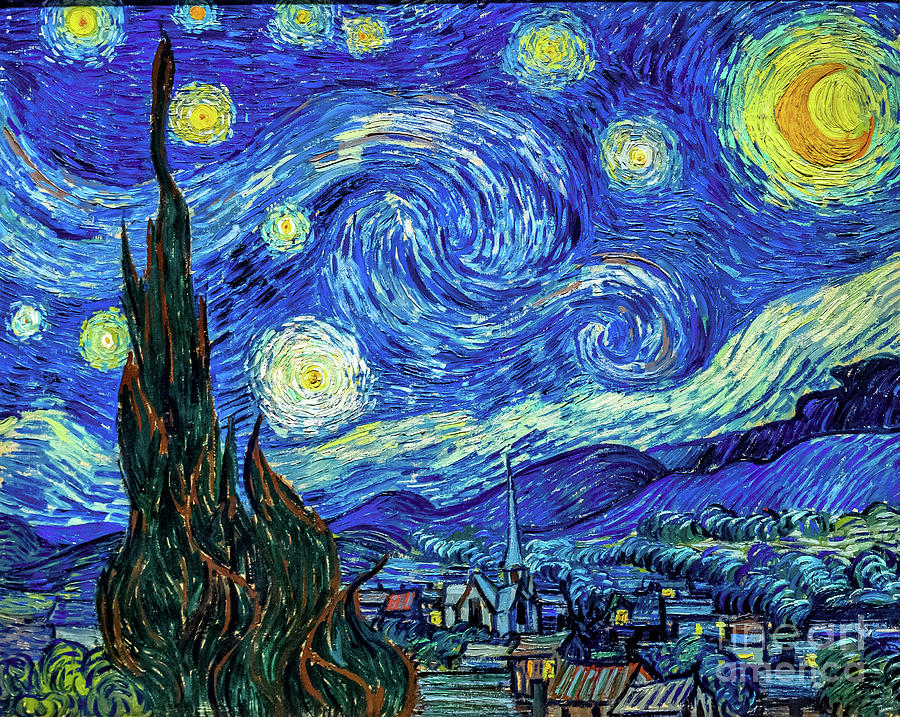
Starry Night (Vincent van Gogh)
[Image from ArcGIS StoryMaps]

I can only gaze with wonder and awe at the depths and heights of our psychic nature. Its non-spatial universe conceals an untold abundance of images which have accumulated over millions of years of living development and become fixed in the organism. My consciousness is like an eye that penetrates to the most distant spaces, yet it is the psychic non-ego that fills them with non-spatial images. And these images are not pale shadows, but tremendously powerful psychic factors.

The most we may be able to do is misunderstand them, but we can never rob them of their power by denying them. Beside this picture, I would place the spectacle of the starry heavens at night, for the only equivalent of the universe within is the universe without; and just as I reach this world through the medium of the body, so I reach that world through the medium of the psyche.

~ C.G. Jung, (from Edward Hoffman's The Wisdom of Carl Jung)


I'm going to start by telling you something about me; in my profile I talk about how I've basically spent my entire life studying psychology, and there's a very good reason for this. It's because I was looking for a way to fix myself. I had a difficult childhood, was bounced from home to home and family member to family member. Though I didn't realize it (because I'm an INTP and don't really have access to my feelings) I never understood how much this wounded me until I was already well into adulthood, but I suffered. Between that and being an introvert in an extroverted culture that looks down on introversion (this was before being an introvert became trendy with the popularity Susan Cain's book Quiet) I felt that there was something fundamentally wrong with me and was desperate to fix it.

“Neurosis is always a substitute for legitimate suffering”
― Carl Gustav Jung

I tried everything: individual therapy, group therapy, inner child work, affirmations, subliminal learning, neuro linguistic programming, and many more, too many to remember. I delved into Jung's work back in the 90's though it didn't “take” then. I had to wait until around 10 years ago for me to really get into it. By this time I had given up on psychology being able to do anything beyond very surface, psychological band-aids. No matter how many times you look in the mirror and tell yourself how awesome you are, you know the truth. You can't cognitive-behavioral-therapy your way out of what you know. So I gave up trying to fix myself and decided to become a librarian.

And then Jung re-entered my life and... I changed. For the very first time, something worked! It didn't work the way I had planned or wished (it never does) but I could feel it, I could see it. Other people could see it! Because the thing that was missing was the depth. The only way you can fix a problem is to go where the problem actually exists, and psychological problems, the serious ones that affect the entirety of one's life, are rooted in the depths one's psyche, or mind. Therefore, the only way to fix them is to go into the depths of the psyche, that is, the unconscious.


Into the ultraviolet

Reptiles (MC Escher)

“Until you make the unconscious conscious, it will direct your life and you will call it fate.”
― Jung

The problems we have in our lives are just symptoms of issues in the unconscious, the deep layer underlying our conscious self, our “I.” If I fall in love with a terrible person and my friends tell me he's terrible, and give reasons why and then I'm like “Oh, he's a douche! I'm going to break up with him!” that's a problem on the level of consciousness and can be solved on that level. If, however, I refuse to listen and insist that he really does love me even though he's physically and emotionally abusive, then that's probably a problem that originates in the unconscious. The only real way to solve a problem is to go where it is. The unconscious is where our most tenacious personal problems exist, the only way to truly solve them is to work with it.

The inner, subjective world and the outer, objective one are mirrors of each other. Just as there are lands and peoples, an entire universe, in our outer reality so too are there lands, peoples, planets, and worlds within. It's a strange, magical reality, a true mirror to the rational, logical reality of the daylight world of consciousness but it's no less real, and no less powerful. We have people and things in our outer, objective reality that we need to deal with. In that situation, we need to work on the outer level. However, we also have people and things - that is, complexes and archetypes - in our inner, subjective reality that we also need to deal with. We use our conscious mind to deal with outer reality. We need to go into our personal unconscious to deal with inner reality.

Everything you do here, all of the houses, everything, was fantasy to begin with, and fantasy has a proper reality. That is not to be forgotten; fantasy is not nothing. It is, of course, not a tangible object, but it is a fact, nevertheless. It is a manifestation of something, and that is a reality.
― Jung

Jung compared these two worlds - outer, objective reality and inner, subjective reality - to the two poles of the light spectrum, the infrared and ultraviolet ends of the spectrum. At the infrared end is the body; instincts, physiological symptoms, physical perceptions; the “real world” expressions of the archetype. At the opposite end is spirit; ideas, dreams, fantasies, religious imagery, complexes; the psychological, ultraviolet end of the human psyche.

For example, the Mother archetype can come to us physically, through an outer person, or the urge to nurture, or maybe a constant hunger. If a person has Mother hunger and she keeps trying to stuff it down with food, or find some person to provide the mothering she missed, this is an attempt to work with the archetype on the infrared side, the side of instinct and physical reality. The ultraviolet side of the archetype would be dream figures, an inner image of the Mother, or the feeling of love, or a lack of it; the complex. A complex is an aggregation of feelings, thoughts, images, and expectations around the nucleus of an archetype; it's our personal, individual psychic expression of it. This is the end we need to work at.

We have to work on psychological problems on the symbolic level, that’s the level you need to be at in order to make deep, lasting changes. If we work on things on the conscious level, the infrared level, we just keep repeating them over and over, never changing or growing out of them. This is because we need to become conscious; those contents of the unconscious that are pushing upwards need to be brought into the light. Unless we deal with the problem on the symbolic level we don’t increase consciousness. Compulsions, obsessions, even physical problems like illnesses or even accidents, are our unconscious attempts to try to solve these inner problems but unless we increase consciousness we will never change. However, if we do manage to do so we can, and will, change. Not by getting rid of the problem but by growing out of it; in comparison to our new, larger personality what was once a huge, looming dragon becomes a tiny little gecko. The Self wants to help us, wants to increase consciousness in us, and through us the world. That’s exactly why we get problems. Our problems are the Self's gift to us to help us grow, to become more and more whole. These problems are the catalyst that allow us to bring more of who we really actually are into the world.
The realization and assimilation of instinct never takes place at the red end, i.e., by absorption into the instinctual sphere, but only through integration of the image which signifies and at the same time evokes the instinct, although in a form quite different from the one we meet on the biological level.

Psychologically the archetype as an image of instinct is a spiritual goal toward which the whole nature of man strives; it is the sea to which all rivers wend their way, the prize which the hero wrests from the fight with the dragon.
- Jung, “On the Nature of the Psyche”

This process isn’t about becoming spiritual. It isn’t even about becoming a better person, though that’s not an uncommon result. Spirituality isn’t a prize that once you get it everything is perfect and you are perfect and you live in a permanent state of nirvana. Spirituality is about learning to recognize the sacred that already always surrounds us. Spirituality is just learning to see the soul of the world, a soul that also lives in us. We are imperfect, as the world is imperfect. Learning to swim with the currents of life, to let them flow into you and back out into the world, to do so cleanly and with awareness, regardless of our circumstances, that is spirituality.

The thing to remember is; everything is spiritual practice. You don’t have to make it spiritual, it already is. And the harder the thing is, the more it challenges you, the better. It is literally like working out; the harder it is, the more consistently you do it, the stronger you get. You have resistance to going to the gym - who doesn’t? - that’s spiritual practice. You find yourself in a situation where you can get a huge benefit if you cheat? Spiritual practice. You need to develop one of your scary cognitive functions, huge spiritual practice.

If you bring forth what is within you, what you bring forth will save you. If you do not bring forth what is within you, what you do not bring forth will destroy you.
― The Gospel of Thomas

This process isn't about becoming a perfect human being with no flaws or failures. It's about how owning every part of ourselves leads us to wholeness, to integration of all of our orphan parts. Even now sometimes I feel like the lowest, worst person. I have so many flaws; I’m lazy, unreliable. Struggle to relate emotionally to others. Sometimes I feel like the biggest failure on the planet, that I've disappointed myself and everyone around me. And yet.... I’ve also been graced with moments of such joy, and such connection - a sacred joy, and joyful connection - brief as they may have been. We don't become “better” people, we learn how to better become who we truly are. Jung said that “the privilege of a lifetime is to become who you truly are.” It is only by becoming who we truly are that we open ourselves up to connection with the sacred source of life.

We hold tightly onto nothing; not power, not honor, not adulation, not wealth, not even love. We hold these things gently, like a small, delicate bird. Maybe the bird lands in our open hands. Maybe it doesn’t. The point isn’t having the bird, it’s being present, regardless of what birds may fly to us. It’s experiencing our lives fully. And that includes the ugliness… especially our own ugliness. By experiencing all that life is, by accepting all that we are and that others are, we clear away everything that was blinding us to this world soul. The dark side of God wants to be known as much as the Light but it’s a very difficult and dangerous task. If we don’t do it right destruction could result. But, if we don’t even try then that possible result will become a certainty, both for ourselves and the world. The light needs the dark. They are two sides of the same golden coin.

The greatest and most important problems of life are all in a certain sense insoluble. They can never be solved, but only outgrown. This ‘outgrowing’, as I formerly called it, on further experience was seen to consist in a new level of consciousness. Some higher or wider interest arose on the person’s horizon, and through this widening of view, the insoluble problem lost its urgency. It was not solved logically in its own terms, but faded out when confronted with a new and stronger life-tendency.
-  Jung


Everyday spirituality

Gallery (MC Escher)

If we can stay with the tension of opposites long enough — sustain it, be true to it — we can sometimes become vessels within which the divine opposites come together and give birth to a new reality.
 Marie-Louise von Franz

Spirituality isn’t weird, or special, or superpowered. It is average, ordinary, everyday… but the thing is, the “average, ordinary, everyday” is special, and sacred. Spirituality is about seeing the sacred in life. It’s as if most of us can only see a small, black and white image of reality. Those who have had their eyes opened see everything in technicolor… More, they see, feel, smell, and taste reality. They’re finally able to experience reality as it is. Mosts of us are living in Plato’s cave, sitting there trapped, able only to watch the world on a small, crappy old black and white television. But when we're finally able to free ourselves, though, we can go out into the real world and experience it’s ordinary, everyday magic.

This isn’t to say that paranormal events can’t happen; synchronicities remind us that the world is alive. But it’s not something that we should rely on. It’s a gift, not something we should, or even could, trap, enslave, and put to work for us. To use the unconscious in such a way is as shameful and loathsome as it is to use another person. Nature is not here for our use but to manifest the beautiful and terrible glory of God… as is the unconscious, as are we ourselves. To use it for such an ignoble and grotesque purpose as to puff up our insignificant egos is disgusting, and the very definition of sin. And it’s why we’re all in the situation we're in today, with humanity on the brink of self-annihilation.

Faith, hope, love, and insight are the highest achievements of human effort. They are found - given - by experience. But what will he do when he sees only too clearly why his patient is ill; when he sees that it arises from his having no love, but only sexuality; no faith, because he is afraid to grope in the dark; no hope, because he is disillusioned by the world and by life; and no understanding, because he has failed to read the meaning of his own existence?
  Jung

The drive of egotism is, at it's root, a holy desire. Every time we want to be the best, most loved, richest, most popular, or successful, or whatever, what we're really searching for is the Self. This is the golden prize, the heavenly kingdom, that is the goal of every myth and fairy tale. But, because we refuse to accept our legitimate suffering, to do the hard work necessary to redeem our own portion of the sacred, that holy desire turns into something foul and capable only of bringing unnecessary suffering and destruction. Sensation’s divine gift is faith, trust, assurance. For intuition it's hope, aspiration, direction. Feeling's gift is love, connection, cherishing. And thinking, at it's highest level, gives us insight, wisdom, and vision. Peace, hope, love, and wisdom; these are our birthrights. But we will only bring these into the world if we are willing to do our work, and suffer our legitimate suffering, the suffering which belongs to us and is ours.

“A complex can be really overcome only if it is lived out to the full. In other words, if we are to develop further, we have to draw to us and drink down to the very dregs what, because of our complexes, we have held at a distance.”
― Jung

Spirituality isn’t easy. God isn’t a big daddy in the sky who makes everything nice for you if you’re a good little girl. It’s hard. Jesus called on us to follow him, to do as he did. He chose to let himself be crucified. We, too, face the same moral choice; we, too, must allow ourselves to be crucified, must suffer being hung up, pulled in opposite directions, to hang there and hang there and hang there. Suffering is a natural, normal part of life, not something to be avoided. Unnecessary suffering should be avoided but necessary suffering - suffering which is yours, which belongs to you - requires that it be lived out, drunk down to the dregs, in order for you to fulfill the task you were born for.

Trials are a way of making us worthy; making us strong enough, skilled enough, clever enough to succeed at our goal. Each trial teaches us something, makes us stronger, strong enough to overcome the next trial, which prepares us for the one after. The struggle is hard, it’s painful. Whatever the thing in your life is that you least want to do, that is probably the one thing you should do. When difficult, traumatic experiences come to us, accept them for what they are: opportunities to bring you closer to the purpose that you alone can serve.

What about suffering in late life? As Eddinger points out suffering in any age can be understood by the ego as the attempts of the Self to incarnate. The way it feels to the ego when we’re suffering is unpleasant but it’s often simply God trying to incarnate. It means this process trying to occur from below so to speak, because the ego doesn’t know the intention of the Self. If the ego knew the intention of the Self it wouldn’t hurt so much. Jung writes about this; he says as we extend our consciousness into the unconscious we contact spheres of a not yet transformed God, so as the ego in later life brings this material up and thinks about it and articulates it, that helps to transform the Self or helps to transform the as yet unconscious God, or aspects of the Self.
 - Lionel Corbett

It is hard to accept: the fire has to burn the fire, one just has to burn in the emotion till the fire dies down and becomes balanced. That is something which unfortunately cannot be evaded. The burning of the fire, of the emotion, cannot be tricked out of one’s system; there is no recipe for getting rid of it, it has to be endured. The fire has to burn until the last unclean element has been consumed, which is what all alchemical texts say in different variations and we have not found any other way either. It cannot be hindered but only suffered till what is mortal or corruptible, or, as our text says so beautifully, till the corruptible humidity, the unconsciousness, has been burnt up. That is the meaning, it is the acceptance of suffering.”
- Marie-Louise von Franz


Everything is part of spiritual practice. The MBTI gives us an idea of what it is precisely that we as individuals need to do, what’s the crap that we’re personally avoiding. Maybe our spiritual practice is enduring the awkwardness and humiliation social interactions, as is my case. Yours will be unique to you and your type. Whatever it is, we need to do it and do it and do it, and cook ourselves in all those negative emotions. As we do so we cook out the bad water, the unconsciousness of the Unconscious, leaving behind only pure, clean, nourishing water.
The best definition of wisdom actually, which at first I thought was the most naive definition, is the definition of Meister Eckhart, but it’s the hardest of all to achieve. His definition is that wisdom consists in doing the next thing you have to do, doing it with your whole heart, and finding delight in doing it. I find that’s probably the most profound definition but the hardest, because usually what you have to do next is some crap that you don’t want to have to do. So that’s very hard to get to. But if you do get to it, then it has a certain meaning that we’ll perhaps come to.
- Lionel Corbett


Rebirth

Hand with Reflecting Sphere (MC Escher)

One of the major difficulties that we have is the ego thinks that ego knows how the individual ought to be. But we are not who we think we are. It’s very important for us to let go of our ego ideas of who we think we are and not have too fixed a smaller self-concept because we need to discover more how the Self thinks the ego ought to be. So the function of old age is the culmination of this lifelong process of clarification, what Freud and Scott Maxwell calls “discovering your essence,” and making conscious all your disparate parts of yourself with the aid of ego consciousness, or, as Jung says, helping the creator to become conscious of his creation. Or developing the ego into a model of the Self, which it really is, or as he quotes Silesius: “I am God’s child and son and He is mine.” That’s what that means psychologically. The Self that’s present at birth can become more conscious of itself throughout life. Then psychological development and spiritual development are absolutely synonymous, only the words are different, but the process is the same.
- Lionel Corbett, “Jungian Views on Aging”


Question: Why do we humans live for so long? This has always been the case; among hunter-gatherers, barring accidents or illnesses, people generally lived to around age 85. We can assume that our hunter-gathering ancestors were the same. But why would this be so? Nothing exists in nature that doesn’t serve a purpose. Like tails on humans or feet on whales, if a thing doesn’t serve the animal it evolves out of existence. So why do women live nearly half of their lives unable to give birth anymore? Why do men live so many years after their ability to out-compete all those strong, young men wanes? If the tasks of youth and adulthood are work and family, what does it mean that we live so many years, decades even, after continuing these tasks is feasible? What are the tasks of this final stage of life?

Our first task of the second half of life is to develop the parts of ourselves that we were never really able to, being so busy living our lives. In the first half of life we develop our stronger, easier functions. This happens naturally; that which you are good at gives you pleasure, and brings rewards, so you keep using it. This continuous use develops these functions to higher and higher levels of proficiency. Those functions that are weak, difficult, and awkward to use are avoided, becoming more and more anemic and atrophied. But these unused parts of ourselves eventually press for recognition; that which has been kept in the darkness longs for the light.

Like a person who only exercises the right side of their body, something starts pushing us to work on the left. Those functions we’ve worked on for so many years start to bore us, like reading the same book, or playing the same video game for decades. We start itching to stretch ourselves beyond that which has become stale and overly familiar. Previously avoided parts of us become wondrous, exciting new lands for us to explore.

The fruits of biological life are children, but the fruit of psychological life, especially in late life, is meaning.What old people have to do is make meaning and make culture, make new ideas, not compete with the young. They have a different responsibility, and their fecundity is a spiritual fecundity and the production of new meaning.
― Lionel Corbett

Our second task is finding meaning. Because we have complexes we repeat certain things over and over again. By looking back over our lives, with all it’s ups and downs and round and rounds, certain themes begin to emerge. We start seeing the connections between what happened to us, and the great myths being played out through us. This process needs to be approached with seriousness and courage because it can be very dangerous to the individual’s psychological well being. At first our memories are disjointed, our lives seem meaningless and absurd. We feel shame and grief at the discrepancy between the promise of youth and what we actually managed to accomplish. We can’t find the connections between events.

When unsuccessful it can lead to mordancy, regret, stagnation, even despair. But when successful it leads to acceptance, and allows for further development. By looking back over our lives we learn what our nature really is. And here’s the thing; if we don’t undertake this difficult and harrowing task it will still lead to bitterness, emptiness, and despair. You can’t actually avoid it, not without paying an even greater price. These are the bitter, ill-tempered aged; moody and dejected, fixated on all that they've lost. Jung wrote that life’s natural upward movement in the first half of life keeps us optimistic and generally moving forward. But, in the second half, unless we have contact with the sacred the slow ebbing away of vitality leaves us stranded in a sour, barren old age.

“Tears, sorrow, and disappointment are bitter, but wisdom is the comforter in all psychic suffering. Indeed, bitterness and wisdom form a pair of alternatives: where there is bitterness wisdom is lacking, and where wisdom is there can be no bitterness.”
— Jung

Contact with the Self is essential, especially in later life. Without it we become bitter and full of self-pity. When we have a relationship with the Self we transcend the personal while, at the same time, becoming genuinely individual. It gives us a different view of death; death now has a positive value as it’s understood to be a rebirth, not an end. We begin living in sacred, eternal time - kairos - while at the same time we live even more fully in everyday, chronological time. The mundane and the divine are united within us.

At the end of every stage of life we are required to give something up, so that we might attain something new. Just as an infant needs give up the bottle and diaper to become a toddler, we need to let go of that which cannot be, which is no longer good for us. In this way we are able focus on that which we can and should be. Our elder years, from approximately 65 to 85, are as long as childhood. This time wouldn’t exist if it didn’t serve an important purpose; the development of spiritual meaning, a spiritual life. The spiritual gifts of peace, hope, love, and wisdom, which are only attained after our long battle with the formidable dragon of our fears.

The purpose of our maturation is to enable the Godhead to rejuvenate, if we could only understand that. When we are born God is old; when we grow old, God becomes young; and when we die, God experiences rebirth. And this goes on and on, but not in the sense that the Godhead is feeding on us, but the whole thing is rather a natural process which is not yet too well understood. It is absolutely essential that, particularly in old age, we do not lose or have lost our connectedness with the Godhead for otherwise we not only deprive God of our share in His rejuvenation, but may actually disturb the cosmic ecology which, in turn, affects us. Ideally, so the voice says, we gain wisdom as we grow older, but only few people do. To accumulate knowledge per se is not all that important; what is important is that we are connected with the Godhead or the Divine, and let it live within us, even though it is also outside of us. Belief in a cosmic Supreme Being or Power constellates the inner child and thus furthers the divine rejuvenation process. If we ignore the divine element, it sinks into itself and ceases to be conscious of itself. As we grow older we often lose the child, and as we lose the child we are apt to simultaneously sever our ties to the divine. There was also some indication that the birth and the death process are actually the same except that as little children we seem to be contained in the Divine element, whilst in old age we are apparently expected to be a container for the Divine element.
- Lionel Corbett, “Jungian Views on Aging”

There is an archetype of the divine child in us, as there is an inner archetype of the wise elder. The Child is unconscious totality, the totality before consciousness; Jung’s 200 million year old man. The Elder recapitulates this totality but at a higher level, as the Elder has regained this totality after bringing the various parts of the psyche into consciousness. This consciousness is the fruit of a lifetime of differentiations and reunifications, constantly enlarging the personality by bring more of the as yet unreconstructed parts of the Self into the light of consciousness.

Before the existence of ego there is no consciousness; despite it’s many shortcoming there can be no consciousness without ego. By going through this process, it’s the ego that allows the Self to constantly get born. Our purpose is to give birth to God, as God gave birth to us. If we do everything right, when we die God is reborn. The Self gives birth to ego in childhood, then ego, in it's turn, gives birth to the Self in elderhood.

“For the alchemist the one primarily in need of redemption is not man, but the deity who is lost and sleeping in matter. Only as a secondary consideration does he hope that some benefit may accrue to himself from the transformed substance as the panacea, the medicina catholica, just as it may to the imperfect bodies, the base or 'sick' metals, etc. His attention is not directed to his own salvation through God's grace, but to the liberation of God from the darkness of matter.
― Jung

Increasing consciousness redeems the God that lives within us. We must bring Them into the world, no matter how difficult and painful it might be, thereby also redeeming the God that lives in the world. Individuation is the goal; it is incarnation on the one hand, and differentiation on the other. It's rebirth, both of oneself and of God. New images continually rise up from the unconscious as revelation. Through these images new consciousness is possible, and this new consciousness is what makes this whole process take place. What does that mean for you? What is the flower waiting deep in your soul to bloom into the light? What is the unreconstructed part of God that you are being asked to give birth to? This is reunification of divine unity, the re-establishment of Totality. The rebirth, not only of ourselves but also of God.

The losses of old age, which seem very painful, actually enhance our own differentiation. As Jane Will writes, we have to take back our projections from the world. We project onto the world the way we think it is. When all those things die off those projections have to be taken back, and we see things the way they really are. We have to find what was lost on the outside, symbolically, on the inside. That’s the idea of finding the whole world in the microcosm, or, as the Gospel of St. Thomas also says; whoever finds himself is superior to the world.
- Lionel Corbett, “Jungian Views on Aging”


Links

Jungian Views on Aging
The Self
The flower of humanity


Sources

Marie-Louise von Franz, Alchemy
Marie-Louise von Franz, “The Hidden Source of Self-Knowledge,” Dreams
CG Jung (from John Beebe's Energies and Patterns in Psychological Type)

A huge debt is owed to analyst Lionel Corbett. His talk “Jungian Views on Aging” (from the Jungianthology Podcast) forms the basis of the final section. I doubt this would have been written, or at least it would have taken me a long time to figure out, without it. We stand on the shoulders of giants, and hopefully provide a platform from which future generations can surpass us.


Tuesday, March 10, 2020

Reference: “The Hidden Source of Self”

[Image from Down Home Essentials]

"We are not human beings having a spiritual experience. We are spiritual beings having a human experience."

~ Pierre Teilhard de Chardin

This is the full text of the subchapter of the book that one of the quotes from the post on projection comes from. It’s really great, very useful, so I’m including it here. Very well worth the read, as is anything from my favorite Jungian, the analyst Marie-Louise von Franz.


We probably project all the time, in everything we do; in other words, in addition to those other impressions which are conveyed by the senses, there are always psychosomatic influences from within, so that we have a general impression of our experiences; Gestalt psychology demonstrates this in many individual cases. Therefore we must either widen our concept of projection to such an extent that, like the East Indians, we look upon everything as projection; or we must draw a line between what we will refer to as projection and what is a relatively objective statement concerning outer objects. Jung suggested that the concept of projection be applied only where there is a serious disturbance of adaptation, that is to say, where either the person who is doing the projecting or all those in his immediate vicinity unanimously reject the statement in question. For the usual mixture of subjectivity in our image of reality, a mixture which is limitless, Jung uses the expression archaic identity, archaic because this was man’s original condition, namely one in which he saw all psychic processes in an “outside” – his good and evil thoughts as spirits, his affects as gods (Ares, Cupid), and so on. Only gradually were certain psychic processes, which were visualized before as exclusively “outside,” understood as processes within the experiencing subject himself, as for instance when the Stoic philosophers began to interpret the goddess Athena as insight, Ares as aggressive passion, Aphrodite as desire; this, so to speak, was the beginning of an “incarnation” of the gods in man.

How far such a process can go – a process, that is, of an increasing development of consciousness – is therefore not easy to foresee. We still know pitifully little about objective man, as Jung emphasized time and again. In spite of being disturbing and socially dangerous, projections also have meaning; for it is apparently only through projections that we can make ourselves conscious of certain unconscious processes. Through projections there arise, first of all, those fascinations, affects, entanglements which then force us to reflect on ourselves. There is no becoming conscious without the fires of emotion and suffering. The disturbance of adaptation which is closely linked with every projection leads, if all goes well, to reflection (if it goes badly it leads to homicide and murder.) Re-flexio, however, means that the image which has been “radiated” outward onto another object is “bent back” and returns to oneself. It is just because the symbol of the mirror has to do psychologically with the phenomenon of projection that it has, mythologically, such an enormous magical significance. In a mirror one can recognize oneself or see a projection. An old Scottish shepherd who lived a secluded life found a pocket mirror one day which a tourist had lost. He had never seen such a thing before. Time after time he looked at it, was amazed, shook his head, then took it home with him. His wife watched with increasing jealousy as, time and again, he furtively drew something out of his pocket, looked at it, smiled, put it back. When he was away one day she quickly took the mirror out of his coat pocket. Looking at it, she cried, “Aha! So this is the old witch he is running after now!”

That “constant flow of projections” – that is to say, that activity in which the subjective intrapsychic elements in our experience of the outer world does not disturb adaptation – Jung, as mentioned above, has called archaic identity, from which all genuine, true knowledge originates, for it is based on an instinctual, mystic participation with all things and all other people. “It is as if the ‘eyes of the background,’” as Jung describes it, “do the seeing in an impersonal act of perception.” These eyes see accurately. Why then do all those projections which disturb adaptation and which must be corrected through conscious insight also come from the same unconscious background? This is probably connected with what we call the dissociability of the psyche. Our entire psyche seems to consist of separate complexes which gather together into what one could call the psychic individuality, just as the Mendelian units of our hereditary factors together to form a unity.

We can clearly see in a small child, who still possesses a very labile ego-consciousness, how loosely the separate complexes live with each other in the moods which change like lightning and by means of which the youngster can switch from “loving child” to “devil” and vice versa, one moment completely affectionate, the next minute utterly engrossed in his play, one moment in deep despair, two minutes later joyful again, sucking a candy. These fluctuations decrease slowly as the conscious ego gradually builds itself up, but then the ego often experiences collisions of the individual complex-impulses within and must then learn to endure and control them. Once, when I was nine, I wanted to draw a picture of my dog whom I loved passionately, but he wouldn’t sit still. I was furious so I smacked him and shouted at him. I will never forget that dog’s innocent, offended look! I did not hit him again, but when I sat down to finish my drawing I felt clearly within me how the fury of my impatience and my love for the dog clashed painfully together. Jung conjectured once that ego consciousness first develops from collisions of the small child with the outer world and later from collisions of the growing ego with the impulses from its own inner world (as in the example of my fury with the dog). The “parliament of instincts,” as Konrad Lorenz would have called it, is not a peaceful organization within us; it is rather violent in there, and the President – the ego – often has difficulty asserting himself. From a practical point of view we can observe that whenever a complex becomes autonomous, then there always arise projections which disturb adaptation and blur the “mirror of inner truth.”

People in one’s immediate neighborhood experience our projections as emotional exaggerations. Personally, I listen almost unconsciously to the tone in which analysands speak about their marital partner, their friends and enemies, and I have discovered that I simply “switch over” whenever a certain undertone of hysterical exaggeration is heard together with the rest of the patient’s statement. Then one can no longer quite believe what is being said, but instead listens to an interesting (unconscious) self-presentation of the analysand. If one succeeds in that moment in relating such an outburst to a dream motif which pictures the statements figuratively, then there is often a good chance that the other will see that all that he has described so enthusiastically or so angrily is really in himself. The withdrawal of a projection, however, is almost always a moral shock. People with weak egos are often unable to tolerate this and resist violently. Jung once compared the ego with a person who navigates his sturdy or flimsy boat on the sea of the unconscious. He hauls fish (the contents of the unconscious) into his boat, but he cannot fill the boat (i.e., integrate unconscious contents) with more fish than the size of the boat allows; if he takes in too many the boat sinks. That is why the elucidation and withdrawal of projections is a critical matter. Schizoid and hysterical personalities can usually take only a little. With primitive people who have a weak ego, it is also advisable to leave projections unexplained. It has been my experience that then the older, more historical ways of dealing with autonomous complexes work better, namely that one refers to them as “spirits” which do not belong to the individual and thus one helps the analysand to resist such a “spirit” through some ritual or magic practice. This means that one takes literally what has been preserved as a figure of speech: “The devil has gotten into him” or that being in love is a “bewitchment.” However, any decisions about these inner moral insights will be made not by the ego and not by the analyst but by the Self. So we are in fact just as the Self sees us with its inner eyes which are always open, and all our own efforts toward self-knowledge must get to this point before any inner peace is possible.

However, the mandala (as the principle of the Self) has a strict mathematical order – like the symbol of the mirror – for, seen from a physical point of view, only those material surfaces which have no distortions, whose molecules are well-arranged, are capable of reflection. Therefore, it would appear as though the truth of one’s own being were being reflected there, in the innermost core of the soul – from there come our dreams, which show us how we really are, whereas the distorting projections come from partial complexes which have made themselves autonomous. This is why Zen masters tell their pupils, time after time, that they should free their “inner mirror” (Buddha-mind) of dust.

As long as we live, our reflection tries to penetrate into the deeper secrets of our innermost being, but what urges us to this is the Self itself, for which we search. It searches for itself in us. It seems to me that it is this secret to which a dream of Jung points, which he had after a severe illness in 1944, and which he relates in his memoirs. In this dream he is walking through a sunny, hilly landscape when he comes to a small wayside chapel. “The door was ajar, and I went in. To my surprise there was no image of the Virgin on the alter, and no crucifix either, but only a wonderful flower arrangement. But then I saw that on the floor in front of the altar, facing me, sat a yogi – in lotus posture, in deep meditation. When I looked at him more closely, I realized that he had my face. I started in profound fright, and awoke with the thought: ‘Aha, so he is the one who is meditating me. He has a dream and I am it.’ I knew that when he is awakened, I would no longer be.”

The dream, Jung continues,
is a parable: My Self retires into meditation and meditates my earthly form. To put it another way: it assumed human shape in order to enter three-dimensional existence, as if someone were putting on a diver’s suit in order to dive into the sea. When it renounces existence in the hereafter, the Self assumes a religious posture, as the chapel in the dream shows. In earthly form it can pass through the experiences of the three-dimensional world, and by greater awareness take a further step toward realization.
The figure of the yogi represents, as it were, Jung’s prenatal wholeness whose meditation “projects” the empirical reality of the ego. As a rule we see these things in reverse, we discover mandalas in the products of the unconscious and express therewith our idea of wholeness. Our basis is ego-consciousness, a field of lights centered upon the focal point of the ego. From that point we look out upon an enigmatic world of obscurity and do not know how far its shadowy forms are caused by our consciousness and how far they possess a reality of their own. The tendency of the dream, writes Jung,
is to effect a reversal of the relationship between ego-consciousness and the unconscious, and to represent the unconscious as the generator of the empirical personality. This reversal suggests that in the opinion of the “Other side,” our unconscious existence is the real one and our conscious world a kind of illusion, an apparent reality constructed for a specific purpose… Unconscious wholeness therefore seems to me the true spiritus rector of all biological and psychic events. Here is a principle which strives for total realization – which in man’s case signifies the attainment of total consciousness. Attainment of consciousness is culture in the broadest sense, and self-knowledge is therefore the heart and essence of this process. The Oriental attributes unquestionably divine significance to the Self, and according to the ancient Christian view of self-knowledge is the road to knowledge of God.
You see why I have called this paper “The Hidden Source of Self-Knowledge”; it lies within us and yet is an unfathomable secret, a complete cosmos which we have only begun to explore.

- Marie-Louise von Franz, Dreams

Once upon a time, I dreamt I was a butterfly, fluttering hither and thither, to all intents and purposes a butterfly. I was conscious only of my happiness as a butterfly, unaware that I was myself. Soon I awaked, and there I was, veritably myself again. Now I do not know whether I was then a man dreaming I was a butterfly, or whether I am now a butterfly, dreaming I am a man.”
- Zhuangzi

Friday, February 28, 2020

"Clean, stainless. Unbeaten."

[Image from The Goddess Garden]

Yes. It is the withdrawal from the emotions; you are no longer identical with them. If you succeed in remembering yourself, if you succeed in making a difference between yourself and that outburst of passion, then you discover the Self; you begin to individuate.

So in anahata individuation begins. But here again you are likely to get an inflation. Individuation is not that you become an ego – you would then become an individualist. You know, an individualist is a man who did not succeed in individuating; he is a philosophically distilled egotist.

Individuation is becoming that thing which is not the ego, and that is very strange. Therefore nobody understands what the Self is, because the Self is just the thing which you are not, which is not the ego. The ego discovers itself as being a mere appendix of the Self in a sort of loose connection. For the ego is always far down in muladhara and suddenly becomes aware of something up above in the fourth story, in anahata, and that is the Self.

Now, if anybody makes the mistake of thinking that he lives at the same time in the basement and on the fourth story, that he is the purusha himself, he is crazy. He is what the German very aptly call verrückt, carried off his feet up to somewhere else. He just sits up there and spins. We are allowed to behold only the purusha, to behold his feet up there. But we are not the purusha; that is a symbol that expresses the impersonal process.

The Self is something exceedingly impersonal, exceedingly objective. If you function in your Self you are not yourself – that is what you feel. You have to do it as if you were a stranger: you will buy as if you did not buy; you will sell as if you did not sell. Or, as St. Paul expresses it, “But it is not I that lives, it is Christ that liveth in me,” meaning that his life had become an objective life, not his own life but the life of a greater one, the purusha.
- Carl Jung, The Psychology of Kundalini Yoga (Carl Jung Depth Psychology)

Anahata or heart chakra is the fourth primary chakra... In Sanskrit, anahata means "unhurt, unstruck, and unbeaten". Anahata Nad refers to the Vedic concept of unstruck sound (the sound of the celestial realm). Anahata is associated with balance, calmness, and serenity.

In Sanskrit Anahata means "sound produced without touching two parts" and at the same time it means "pure" or "clean, stainless". The name of this chakra signifies the state of freshness that appears when we are able to become detached and to look at the different and apparently contradictory experiences of life with a state of openness (expansion). Normally we are not used to the effect produced by the confrontation of the two opposite forces. At the level of Anahata chakra appears the possibility to integrate the two opposite forces and obtain the effect, without the two forces being confronted. This energy is specific to cooperation and integration, which brings peace and a new perspective in a world which, up to this level was made only of a more or less conscious confrontation between opposite forces.
Anahata (Wikipedia)


Just throwing this out there because it's very useful. One of the most impactful practices I ever developed was learning how to deal with emotions, to step back from them, and observe them and myself from a distance. We think we have our emotions but our emotions really have us; when in the grip of a passion our egos become eclipsed, possessed. It's not easy to get yourself unpossessed - I still often fail - but without space between your feelings and yourself you can't begin to discriminate "ego" from "not ego."

Years ago I developed the following practice: When I feel something painful, instead of trying to escape I lean into it. I envision the emotion as crashing waves that I move into. Each crash then becomes smaller and smaller, until they eventually die out. All passions, no matter how intense, will die out, but only if you let them have space in your mind and in your heart. Otherwise, they become a festering wound that becomes untouchable. Before teaching myself this, I would be overwhelmed with the emotion. I couldn't let myself feel and process anything because it was so overwhelming and painful; it felt like annihilation. The idea that I could actually endure the pain, and survive it, was a revelatory, an epiphany.

Marie-Louise von Franz once wrote (I forget where and I can't find it!) that the dragon - one's pain and suffering - has to burn itself out. The cure for the dragon's fire is it's own fire; you just have to let the flames cook you. But this suffering is really a true and caring friend who brings us precious gifts that allow us to grow.

There is a secret love hiding in each problem.

The psyche is highly flammable material. So we are always wrapping things in asbestos, keeping our images and fantasies at arm's length because they are so full of love.
- James Hillman


Thursday, January 23, 2020

MBTI: House Ash

”The School of Athens,”  Raphael
[Image from Greek Reporter]

“The Philosophers”
Fe/Ti + Si/Ne
(ENTP INTP ESFJ ISFJ)

Home: the Academy
Patron: Gwydion
Quadra: Alpha
Vice: Complacency
Virtue: Wisdom


Ash is the home of the philosophers, whether they’re your typical intellectuals like the INTPs and ENTPs, or your more earthy, practical seekers of wisdom, like the ISFJs and the ESFJs. Here we are at the academy, a place of learning, both for its own sake but also to make the world a better place for all beings.
Like the Saints [Cenobites], the Philosophers judge by aligning with a standard. They’re seeking an outside truth. Unlike the Saints, though, the Philosophers, rather than being intense, committed, and dogmatic are exploratory, multi-faceted, and non-committal. Ne doesn’t commit to any viewpoint because it wants to see more, while Si doesn’t want to commit to a viewpoint because it’s unsure of how the future will unfold; it wants to be ready for anything. Si/Ne is a wormhole, as opposed to Se/Ni’s black hole; while a black hole sucks everything into one singularity, the wormhole provides a short-cut between perspectives, figuring things out quickly and cleverly. Search for truth (with an emphasis on the search), the inquiry, and the non-committal analysis. SFJs are more philosopher farmers, like Odysseus from the Illiad; wise, practical, caring, stern, “focused on the important, real things in life,” but, despite how they may appear, are actually exceptionally thoughtful.

ESFJ: A kindly, warm-hearted philosopher, helpful and cheerful, but not simply as a result of tradition but of their own Socratic inquiry. They have thought about this and find their way of life more desirable in comparison to other ways of life.

ISFJ: Same as the ESFJ, more stubborn than the ESFJ though, and has a strong motivation to carry out their ideals and convictions. The image of the philosopher-farmer is closer to what the ISFJs really are than a motherly nurturer.

ENTP: This type is best represented by Socrates himself; interested in the inquiry into truth from many angles.

INTP: Similar to ENTP, but the focus is on the organization of the truth within themselves; the development of logical principles over finding them.
- Michael Pierce, “Function Axes Categories”  (YouTube)


Socionics: Alpha Quadra

The Socionics term for this house is the Alpha Quadra. I don’t find a lot of Socionics to be useful or accurate, mainly because they don’t seem to understand the deep, underlying structure of the MBTI, and also because a lot of it seems to be overly intellectual wandering about in the weeds. I understand this well because this is a very NTP thing to do; we INTPs and ENTPs love think and use our minds for bullshit that’s completely untethered from reality. This is also a problem I have with a lot of philosophy. But they are aware of the functions and they seem to have gathered a rather massive quantity of data so many of their observations are useful, even if their theories are a bit dubious sometimes.

According to Socionics this quadra (house) tends to enjoy theoretical discussions for fun rather than for a practical purposes. They value logically consistent beliefs and ideas, and morally consistent behavior. They enjoy positive environments that are pleasing to the senses. They tend to show affection by performing small services or giving small gifts.

They tend to avoid controversial subjects that could lead to unpleasant confrontations and are inclined to be tolerant of past misdeed by others, preferring reconciliation so as to maintain a positive environment. They tend to avoid things that require intensive, long term commitment and upkeep, preferring short term investments of energy that offer a reliable outcome with minimal effort. They prefer experience to advice and often perceive those who try to give such advice as pedantic.

They generally strive to create comfortable, pleasant environments; an ideal situation is the exchange of light-hearted jokes while discussing imaginative ideas over a delicious meal. Games are less about winning or losing and at least as much if not more about the fun they have during them. They generally dislike heaviness, especially confrontation or anything else that could bring the mood down.

Discussions tend to go off on tangents, in whatever directions seems the most interesting at the moment. If they share the same observations about something they’ll usually agree emphatically so as to increase rapport. If a problem is encountered they’ll dive into it and develop it until some kind of satisfactory conclusion is reached.

Alphas are egalitarian and tend to avoid distinctions between insiders and outsiders, easily drawing people in. They generally find formal speech and dress to be pretentious, unnecessarily limiting, and ridiculous.


How Philosophers see other houses:

Beta (Yew): They tend to find Cenobites to be fun, but with a bit of an edge, and inclined to be a bit bossy. They usually give in to Cenobites because they feel the Cenobites care more. They can find them to be overly rigid and single-minded.

Gamma (Oak): They tend to view Aristocrats as standoffish and cold, even hostile, especially in work situations. They also dislike Aristorats’ tendency to play favorites, which is offensive to the fair-minded, egalitarian Philosophers. They can find Aristocrats to be overly harsh, unimaginative, boring, overly concerned about the future, as well as having a mean-streak of unforgivingness and vindictiveness.

Delta (Rowan): Philosophers tend to find Explorers to be kind and creative, if a bit too serious about their ideals and principles and too demanding that others feel and act just as they do about those ideals.


How other houses see Philosophers:

Yew: Cenobites tend to find Philosophers to be fun and creative - pleasant company - but also goofy, lacking focus and ambition, and too concerned with refining ideas and having fun. They often see them as needing to be led. Groups of Philosophers and Cenobites generally get along better in groups than as individuals; as Fe activates Cenobites start telling loud stories, and Philosophers make goofy suggestions for entertainment.

Oak: Initially Aristocrats find Philosophers to be friendly, creative, well-meaning, pleasant people. Later, however, they tend to see them as unambitious and overly concerned with comfort and physical pleasure. They also find them to be oversensitive while, at the same time, failing to make an effort to focus on the deeper feelings involved.

Rowan: Explorers tend to find Philosophers to be fun and interesting people to discuss ideas and prospects with, but also naive and inconsistent in their personal and business affairs. They feel Philosophers are overly idealistic and lacking in common sense, failing to turn their fun ideas into something productive.


Ash

Connection, Wisdom, Surrender
Ash stretches from the underworld to the heavens, uniting the three realms; present, past, and future. The balance between the physical and spiritual realms; balance is the key to strength and wisdom. The Ash is used for spells requiring focus and strength of purpose, linking the inner and outer worlds. Placing ash leaves on one’s pillow is said to stimulate psychic dreams. The seeds resemble keys and have the power to unlock the future.

The Ash is associated with magician, hero, and trickster Gwydion.


A cunning and skilled magician, Gwydion was able to use magic to enhance his own abilities and change the forms of others. While his chief attribute was his deft mind, he was also a capable warrior strong enough to defeat one of Wales’ most powerful lords in single combat. According to medieval Welsh poetry, his magic could create women out of flowers…

Though he was a trickster, Gwydion possessed a strong sense of loyalty to certain members of his family, most notably his nephew Lleu.” [Lleu eventually becomes High King, and Gwydion his advisor. This is an archetypal relationship; the trickster magician and the king.]
- Gregory Wright, "Gwydion fab Don, Celtic Trickster Deity" (Mythopedia)

Gwydion is a kind of mischievous Celtic Merlin; think of a combination of an impish Hermes and wise Merlin. In one legend he started a war with his uncle King Math's rival, Pryderi. His brother was in love with their uncle's foot-holder (Math needed to keep his feet on the lap of a beautiful virgin). He started the war by stealing the rival king's divine pigs through clever trickery, but he ended it by physically defeating him in single combat. In this way Gwydion's foolish chicanery wound up leading to the dramatic expansion of his liege's kingdom. These kinds of fortuitous accidents are quite common with trickster figures like Gwydion fab Don.
Gwydion is a powerful sorceror and master of illusion. He delights in trickery and is thought to have originated April Fools' Day when he conjured the armies to trick Aranrhod into arming Lleu. He is a lover of poetry and the art of the bards, and is the druid of the gods. He is persistent in his ventures and learns from experience. He is both subtle and devious, yet open and honest in his dealings with others. He takes responsibility in his actions and in the actions of his people.
- "The Legend of Gwydion"


I chose Ash to represent the Philosophers as it expresses the central dichotomies of these types; that is, the tension and unity of heart and mind, precious tradition and future possibilities. The sacred task of House Ash is to discover the true, eternal principles for a good life. Ash teaches us that all of us - in fact, every thing - is connected. All of the houses, at their best, bring forth their own special form of wisdom, but Sophia - the wisdom that connects the world together in truth which is love - is the special gift that the dwellers of this house are tasked to bring into the world.

In the academy, we have the ESFJ, greeting all the people in a friendly way, giving advice to those who need help; the ISFJ, quietly working on discourses concerning how to live a good life; in the center is the ENTP, asking fellow philosophers difficult questions, listening carefully to their answers; then there’s the INTP, separate, like the ISFJ, working out their own theories of the universe and it’s nature.
- Michael Pierce, “Function Axes Categories”  (YouTube)


Posts

The Houses
House Oak
House Rowan
Jungian MBTI


Wednesday, January 15, 2020

“Right” and “wrong”

(Image from Drake University)


In Jungian psychology there is no right or wrong, it’s always “what’s right for you?” Honesty can be a good thing for someone else, but maybe you need to learn protective deception. Being goal oriented can be a good thing but maybe you need to learn to relax and let go. Or vice versa.

Marie-Louise von Franz said that, in fairy tales, there are no consistent rules. Sometimes you must lie, and sometimes you get punished for lying. Sometimes the hard worker gets rewarded, and sometimes it’s the village idiot who does nothing but sit around scratching his butt. (There’s only one rule in fairy tales: never harm the helpful animal.)

This is a symbolic reflection of life; everyone is different so everyone needs to balance themselves in different ways. Maybe a workaholic needs to relax, but a lazy person probably needs to get to work. What’s medicine for one person is poison for another. So, what is the goal of Jungian analysis? The short answer is: individuation. That is, recovering our lost parts and integrating them into our conscious selves.

Jungian psychology says that our conscious selves, our egos, are in relation to just a small fraction of the totality of who we are. Most of “us” is actually in the unconscious, like an iceberg submerged in the ocean. Our task is to bring as much of that iceberg above the waterline as we can. So, in Jungian psychology “good” is consciousness, and “bad” is unconsciousness.

This actually gives Jungian psychology a very clear, though individualistic, parameter. If you do things that increase consciousness, you are doing the right thing. If, on the other hand, you’re doing things that increase unconsciousness you are doing “bad.” If you lash out at someone with your Demon function, or attack them with your Critic, you are increasing unconsciousness. If, on the other hand, you accept your weakness in the form of your Animus, or go into your Nemesis consciously to balance out your ego’s weakness, you increase consciousness.

If we do something that we think is “getting over someone” – passive aggressive behavior, cheating, unloading our anger on someone – we will increase unconsciousness in ourselves. This is bad for us. We’re not “getting over” anyone; the person we’re cheating, and hurting, most is us. And, at the same time, we’re also making the world a worse place, increasing unconsciousness in everyone around us, unless they are strong enough to avoid getting caught up in our bullshit. The world and everyone around us end up worse because of our existence.

This is the crux of the moral question: do I do the hard, painful, and not fun thing required of me to increase consciousness? Or do I do the easy, fun thing that increases unconsciousness? One of Marie-Louise von Franz’s analysands wanted to use active imagination to beat, stab, and kill someone she didn’t like (in her head, not IRL). MLvF immediately told her that this was a terrible idea; it wasn’t active imagination, it was black magic (misusing the unconscious for selfish and harmful purposes). It would not only have halted growth, this analysand would have gone backwards, i.e. they would have become even more neurotic, as neuroticism is basically psychology-speak for unconsciousness.

Another example is an ESFP I know who likes playing mind games with people who he feels deserve it. Unconscious ESFPs and ENFPs, thanks to their Fe Critic, have this problem where they tend to judge the people around them to be immoral. This, they feel, gives them license to be completely immoral themselves. The irony of their Fe Critic is that it can lead them to being some of the most immoral people of all the types, but every type does something similar, thanks to our hypocritical, sanctimonious Critic function. The problem is, this ESFP is hurting himself far more than he’s hurting anyone else, because he’s making himself more unconscious.

All of us have a similar tendency, all of us need to be vigilant and moral in our own lives. To do any less is cheating… and the only person we’re really cheating… is ourselves.


See also
The 8 function model


Tuesday, December 17, 2019

Article: “The Holy Grail of the Unconscious”

Credit: Henri Cartier-Bresson


This is a fascinating article, with much importance for anyone interested in Jung and his ideas. I'm posting it here to ensure that we still have access to it should it disappear from the internet.


The Holy Grail of the Unconscious
By Sara Corbett
(New York Times, 9/16/2009)

This is a story about a nearly 100-year-old book, bound in red leather, which has spent the last quarter century secreted away in a bank vault in Switzerland. The book is big and heavy and its spine is etched with gold letters that say “Liber Novus,” which is Latin for “New Book.” Its pages are made from thick cream-colored parchment and filled with paintings of otherworldly creatures and handwritten dialogues with gods and devils. If you didn’t know the book’s vintage, you might confuse it for a lost medieval tome.

And yet between the book’s heavy covers, a very modern story unfolds. It goes as follows: Man skids into midlife and loses his soul. Man goes looking for soul. After a lot of instructive hardship and adventure — taking place entirely in his head — he finds it again.

Some people feel that nobody should read the book, and some feel that everybody should read it. The truth is, nobody really knows. Most of what has been said about the book — what it is, what it means — is the product of guesswork, because from the time it was begun in 1914 in a smallish town in Switzerland, it seems that only about two dozen people have managed to read or even have much of a look at it.

Of those who did see it, at least one person, an educated Englishwoman who was allowed to read some of the book in the 1920s, thought it held infinite wisdom — “There are people in my country who would read it from cover to cover without stopping to breathe scarcely,” she wrote — while another, a well-known literary type who glimpsed it shortly after, deemed it both fascinating and worrisome, concluding that it was the work of a psychotic.

So for the better part of the past century, despite the fact that it is thought to be the pivotal work of one of the era’s great thinkers, the book has existed mostly just as a rumor, cosseted behind the skeins of its own legend — revered and puzzled over only from a great distance.

Which is why one rainy November night in 2007, I boarded a flight in Zurich, pulling up to the airport gate at about the same hour that the main branch of the Union Bank of Switzerland, located on the city’s swanky Bahnhofstrasse, across from Tommy Hilfiger and close to Cartier, was opening its doors for the day. A change was under way: the book, which had spent the past 23 years locked inside a safe deposit box in one of the bank’s underground vaults, was just then being wrapped in black cloth and loaded into a discreet-looking padded suitcase on wheels. It was then rolled past the guards, out into the sunlight and clear, cold air, where it was loaded into a waiting car and whisked away.

THIS COULD SOUND, I realize, like the start of a spy novel or a Hollywood bank caper, but it is rather a story about genius and madness, as well as possession and obsession, with one object — this old, unusual book — skating among those things. Also, there are a lot of Jungians involved, a species of thinkers who subscribe to the theories of Carl Jung, the Swiss psychiatrist and author of the big red leather book. And Jungians, almost by definition, tend to get enthused anytime something previously hidden reveals itself, when whatever’s been underground finally makes it to the surface.

Carl Jung founded the field of analytical psychology and, along with Sigmund Freud, was responsible for popularizing the idea that a person’s interior life merited not just attention but dedicated exploration — a notion that has since propelled tens of millions of people into psychotherapy. Freud, who started as Jung’s mentor and later became his rival, generally viewed the unconscious mind as a warehouse for repressed desires, which could then be codified and pathologized and treated. Jung, over time, came to see the psyche as an inherently more spiritual and fluid place, an ocean that could be fished for enlightenment and healing.

Whether or not he would have wanted it this way, Jung — who regarded himself as a scientist — is today remembered more as a countercultural icon, a proponent of spirituality outside religion and the ultimate champion of dreamers and seekers everywhere, which has earned him both posthumous respect and posthumous ridicule. Jung’s ideas laid the foundation for the widely used Myers-Briggs personality test and influenced the creation of Alcoholics Anonymous. His central tenets — the existence of a collective unconscious and the power of archetypes — have seeped into the larger domain of New Age thinking while remaining more at the fringes of mainstream psychology.

A big man with wire-rimmed glasses, a booming laugh and a penchant for the experimental, Jung was interested in the psychological aspects of séances, of astrology, of witchcraft. He could be jocular and also impatient. He was a dynamic speaker, an empathic listener. He had a famously magnetic appeal with women. Working at Zurich’s Burghölzli psychiatric hospital, Jung listened intently to the ravings of schizophrenics, believing they held clues to both personal and universal truths. At home, in his spare time, he pored over Dante, Goethe, Swedenborg and Nietzsche. He began to study mythology and world cultures, applying what he learned to the live feed from the unconscious — claiming that dreams offered a rich and symbolic narrative coming from the depths of the psyche. Somewhere along the way, he started to view the human soul — not just the mind and the body — as requiring specific care and development, an idea that pushed him into a province long occupied by poets and priests but not so much by medical doctors and empirical scientists.

Jung soon found himself in opposition not just to Freud but also to most of his field, the psychiatrists who constituted the dominant culture at the time, speaking the clinical language of symptom and diagnosis behind the deadbolts of asylum wards. Separation was not easy. As his convictions began to crystallize, Jung, who was at that point an outwardly successful and ambitious man with a young family, a thriving private practice and a big, elegant house on the shores of Lake Zurich, felt his own psyche starting to teeter and slide, until finally he was dumped into what would become a life-altering crisis.

What happened next to Carl Jung has become, among Jungians and other scholars, the topic of enduring legend and controversy. It has been characterized variously as a creative illness, a descent into the underworld, a bout with insanity, a narcissistic self-deification, a transcendence, a midlife breakdown and an inner disturbance mirroring the upheaval of World War I. Whatever the case, in 1913, Jung, who was then 38, got lost in the soup of his own psyche. He was haunted by troubling visions and heard inner voices. Grappling with the horror of some of what he saw, he worried in moments that he was, in his own words, “menaced by a psychosis” or “doing a schizophrenia.”

He later would compare this period of his life — this “confrontation with the unconscious,” as he called it — to a mescaline experiment. He described his visions as coming in an “incessant stream.” He likened them to rocks falling on his head, to thunderstorms, to molten lava. “I often had to cling to the table,” he recalled, “so as not to fall apart.”

Had he been a psychiatric patient, Jung might well have been told he had a nervous disorder and encouraged to ignore the circus going on in his head. But as a psychiatrist, and one with a decidedly maverick streak, he tried instead to tear down the wall between his rational self and his psyche. For about six years, Jung worked to prevent his conscious mind from blocking out what his unconscious mind wanted to show him. Between appointments with patients, after dinner with his wife and children, whenever there was a spare hour or two, Jung sat in a book-lined office on the second floor of his home and actually induced hallucinations — what he called “active imaginations.” “In order to grasp the fantasies which were stirring in me ‘underground,’ ” Jung wrote later in his book “Memories, Dreams, Reflections,” “I knew that I had to let myself plummet down into them.” He found himself in a liminal place, as full of creative abundance as it was of potential ruin, believing it to be the same borderlands traveled by both lunatics and great artists.

Jung recorded it all. First taking notes in a series of small, black journals, he then expounded upon and analyzed his fantasies, writing in a regal, prophetic tone in the big red-leather book. The book detailed an unabashedly psychedelic voyage through his own mind, a vaguely Homeric progression of encounters with strange people taking place in a curious, shifting dreamscape. Writing in German, he filled 205 oversize pages with elaborate calligraphy and with richly hued, staggeringly detailed paintings.

What he wrote did not belong to his previous canon of dispassionate, academic essays on psychiatry. Nor was it a straightforward diary. It did not mention his wife, or his children, or his colleagues, nor for that matter did it use any psychiatric language at all. Instead, the book was a kind of phantasmagoric morality play, driven by Jung’s own wish not just to chart a course out of the mangrove swamp of his inner world but also to take some of its riches with him. It was this last part — the idea that a person might move beneficially between the poles of the rational and irrational, the light and the dark, the conscious and the unconscious — that provided the germ for his later work and for what analytical psychology would become.

The book tells the story of Jung trying to face down his own demons as they emerged from the shadows. The results are humiliating, sometimes unsavory. In it, Jung travels the land of the dead, falls in love with a woman he later realizes is his sister, gets squeezed by a giant serpent and, in one terrifying moment, eats the liver of a little child. (“I swallow with desperate efforts — it is impossible — once again and once again — I almost faint — it is done.”) At one point, even the devil criticizes Jung as hateful.

He worked on his red book — and he called it just that, the Red Book — on and off for about 16 years, long after his personal crisis had passed, but he never managed to finish it. He actively fretted over it, wondering whether to have it published and face ridicule from his scientifically oriented peers or to put it in a drawer and forget it. Regarding the significance of what the book contained, however, Jung was unequivocal. “All my works, all my creative activity,” he would recall later, “has come from those initial fantasies and dreams.”

Jung evidently kept the Red Book locked in a cupboard in his house in the Zurich suburb of Küsnacht. When he died in 1961, he left no specific instructions about what to do with it. His son, Franz, an architect and the third of Jung’s five children, took over running the house and chose to leave the book, with its strange musings and elaborate paintings, where it was. Later, in 1984, the family transferred it to the bank, where since then it has fulminated as both an asset and a liability.

Anytime someone did ask to see the Red Book, family members said, without hesitation and sometimes without decorum, no. The book was private, they asserted, an intensely personal work. In 1989, an American analyst named Stephen Martin, who was then the editor of a Jungian journal and now directs a Jungian nonprofit foundation, visited Jung’s son (his other four children were daughters) and inquired about the Red Book. The question was met with a vehemence that surprised him. “Franz Jung, an otherwise genial and gracious man, reacted sharply, nearly with anger,” Martin later wrote in his foundation’s newsletter, saying “in no uncertain terms” that Martin could not “see the Red Book, nor could he ever imagine that it would be published.”

And yet, Carl Jung’s secret Red Book — scanned, translated and footnoted — will be in stores early next month, published by W. W. Norton and billed as the “most influential unpublished work in the history of psychology.” Surely it is a victory for someone, but it is too early yet to say for whom.

STEPHEN MARTIN IS a compact, bearded man of 57. He has a buoyant, irreverent wit and what feels like a fully intact sense of wonder. If you happen to have a conversation with him anytime before, say, 10 a.m., he will ask his first question — “How did you sleep?” — and likely follow it with a second one — “Did you dream?” Because for Martin, as it is for all Jungian analysts, dreaming offers a barometric reading of the psyche. At his house in a leafy suburb of Philadelphia, Martin keeps five thick books filled with notations on and interpretations of all the dreams he had while studying to be an analyst 30 years ago in Zurich, under the tutelage of a Swiss analyst then in her 70s named Liliane Frey-Rohn. These days, Martin stores his dreams on his computer, but his dream life is — as he says everybody’s dream life should be — as involving as ever.

Even as some of his peers in the Jungian world are cautious about regarding Carl Jung as a sage — a history of anti-Semitic remarks and his sometimes patriarchal views of women have caused some to distance themselves — Martin is unapologetically reverential. He keeps Jung’s 20 volumes of collected works on a shelf at home. He rereads “Memories, Dreams, Reflections” at least twice a year. Many years ago, when one of his daughters interviewed him as part of a school project and asked what his religion was, Martin, a nonobservant Jew, answered, “Oh, honey, I’m a Jungian.”

The first time I met him, at the train station in Ardmore, Pa., Martin shook my hand and thoughtfully took my suitcase. “Come,” he said. “I’ll take you to see the holy hankie.” We then walked several blocks to the office where Martin sees clients. The room was cozy and cavelike, with a thick rug and walls painted a deep, handsome shade of blue. There was a Mission-style sofa and two upholstered chairs and an espresso machine in one corner.

Several mounted vintage posters of Zurich hung on the walls, along with framed photographs of Carl Jung, looking wise and white-haired, and Liliane Frey-Rohn, a round-faced woman smiling maternally from behind a pair of severe glasses.

Martin tenderly lifted several first-edition books by Jung from a shelf, opening them so I could see how they had been inscribed to Frey-Rohn, who later bequeathed them to Martin. Finally, we found ourselves standing in front of a square frame hung on the room’s far wall, another gift from his former analyst and the centerpiece of Martin’s Jung arcana. Inside the frame was a delicate linen square, its crispness worn away by age — a folded handkerchief with the letters “CGJ” embroidered neatly in one corner in gray. Martin pointed. “There you have it,” he said with exaggerated pomp, “the holy hankie, the sacred nasal shroud of C. G. Jung.”

In addition to practicing as an analyst, Martin is the director of the Philemon Foundation, which focuses on preparing the unpublished works of Carl Jung for publication, with the Red Book as its central project. He has spent the last several years aggressively, sometimes evangelistically, raising money in the Jungian community to support his foundation. The foundation, in turn, helped pay for the translating of the book and the addition of a scholarly apparatus — a lengthy introduction and vast network of footnotes — written by a London-based historian named Sonu Shamdasani, who serves as the foundation’s general editor and who spent about three years persuading the family to endorse the publication of the book and to allow him access to it.

Given the Philemon Foundation’s aim to excavate and make public C. G. Jung’s old papers — lectures he delivered at Zurich’s Psychological Club or unpublished letters, for example — both Martin and Shamdasani, who started the foundation in 2003, have worked to develop a relationship with the Jung family, the owners and notoriously protective gatekeepers of Jung’s works. Martin echoed what nearly everybody I met subsequently would tell me about working with Jung’s descendants. “It’s sometimes delicate,” he said, adding by way of explanation, “They are very Swiss.”

What he likely meant by this was that the members of the Jung family who work most actively on maintaining Jung’s estate tend to do things carefully and with an emphasis on privacy and decorum and are on occasion taken aback by the relatively brazen and totally informal way that American Jungians — who it is safe to say are the most ardent of all Jungians — inject themselves into the family’s business. There are Americans knocking unannounced on the door of the family home in Küsnacht; Americans scaling the fence at Bollingen, the stone tower Jung built as a summer residence farther south on the shore of Lake Zurich. Americans pepper Ulrich Hoerni, one of Jung’s grandsons who manages Jung’s editorial and archival matters through a family foundation, almost weekly with requests for various permissions. The relationship between the Jungs and the people who are inspired by Jung is, almost by necessity, a complex symbiosis. The Red Book — which on one hand described Jung’s self-analysis and became the genesis for the Jungian method and on the other was just strange enough to possibly embarrass the family — held a certain electrical charge. Martin recognized the descendants’ quandary. “They own it, but they haven’t lived it,” he said, describing Jung’s legacy. “It’s very consternating for them because we all feel like we own it.” Even the old psychiatrist himself seemed to recognize the tension. “Thank God I am Jung,” he is rumored once to have said, “and not a Jungian.”

“This guy, he was a bodhisattva,” Martin said to me that day. “This is the greatest psychic explorer of the 20th century, and this book tells the story of his inner life.” He added, “It gives me goose bumps just thinking about it.” He had at that point yet to lay eyes on the book, but for him that made it all the more tantalizing. His hope was that the Red Book would “reinvigorate” Jungian psychology, or at the very least bring himself personally closer to Jung. “Will I understand it?” he said. “Probably not. Will it disappoint? Probably. Will it inspire? How could it not?” He paused a moment, seeming to think it through. “I want to be transformed by it,” he said finally. “That’s all there is.”

IN ORDER TO UNDERSTAND and decode the Red Book — a process he says required more than five years of concentrated work — Sonu Shamdasani took long, rambling walks on London’s Hampstead Heath. He would translate the book in the morning, then walk miles in the park in the afternoon, his mind trying to follow the rabbit’s path Jung had forged through his own mind.

Shamdasani is 46. He has thick black hair, a punctilious eye for detail and an understated, even somnolent, way of speaking. He is friendly but not particularly given to small talk. If Stephen Martin is — in Jungian terms — a “feeling type,” then Shamdasani, who teaches at the University College London’s Wellcome Trust Center for the History of Medicine and keeps a book by the ancient Greek playwright Aeschylus by his sofa for light reading, is a “thinking type.” He has studied Jungian psychology for more than 15 years and is particularly drawn to the breadth of Jung’s psychology and his knowledge of Eastern thought, as well as the historical richness of his era, a period when visionary writing was more common, when science and art were more entwined and when Europe was slipping into the psychic upheaval of war. He tends to be suspicious of interpretive thinking that’s not anchored by hard fact — and has, in fact, made a habit of attacking anybody he deems guilty of sloppy scholarship — and also maintains a generally unsentimental attitude toward Jung. Both of these qualities make him, at times, awkward company among both Jungians and Jungs.

The relationship between historians and the families of history’s luminaries is, almost by nature, one of mutual disenchantment. One side works to extract; the other to protect. One pushes; one pulls. Stephen Joyce, James Joyce’s literary executor and last living heir, has compared scholars and biographers to “rats and lice.” Vladimir Nabokov’s son Dmitri recently told an interviewer that he considered destroying his father’s last known novel in order to rescue it from the “monstrous nincompoops” who had already picked over his father’s life and works. T. S. Eliot’s widow, Valerie Fletcher, has actively kept his papers out of the hands of biographers, and Anna Freud was, during her lifetime, notoriously selective about who was allowed to read and quote from her father’s archives.

Even against this backdrop, the Jungs, led by Ulrich Hoerni, the chief literary administrator, have distinguished themselves with their custodial vigor. Over the years, they have tried to interfere with the publication of books perceived to be negative or inaccurate (including one by the award-winning biographer Deirdre Bair), engaged in legal standoffs with Jungians and other academics over rights to Jung’s work and maintained a state of high agitation concerning the way C. G. Jung is portrayed. Shamdasani was initially cautious with Jung’s heirs. “They had a retinue of people coming to them and asking to see the crown jewels,” he told me in London this summer. “And the standard reply was, ‘Get lost.’ ”

Shamdasani first approached the family with a proposal to edit and eventually publish the Red Book in 1997, which turned out to be an opportune moment. Franz Jung, a vehement opponent of exposing Jung’s private side, had recently died, and the family was reeling from the publication of two controversial and widely discussed books by an American psychologist named Richard Noll, who proposed that Jung was a philandering, self-appointed prophet of a sun-worshiping Aryan cult and that several of his central ideas were either plagiarized or based upon falsified research.

While the attacks by Noll might have normally propelled the family to more vociferously guard the Red Book, Shamdasani showed up with the right bargaining chips — two partial typed draft manuscripts (without illustrations) of the Red Book he had dug up elsewhere. One was sitting on a bookshelf in a house in southern Switzerland, at the home of the elderly daughter of a woman who once worked as a transcriptionist and translator for Jung. The second he found at Yale University’s Beinecke Library, in an uncataloged box of papers belonging to a well-known German publisher. The fact that there were partial copies of the Red Book signified two things — one, that Jung had distributed it to at least a few friends, presumably soliciting feedback for publication; and two, that the book, so long considered private and inaccessible, was in fact findable. The specter of Richard Noll and anybody else who, they feared, might want to taint Jung by quoting selectively from the book loomed large. With or without the family’s blessing, the Red Book — or at least parts of it — would likely become public at some point soon, “probably,” Shamdasani wrote ominously in a report to the family, “in sensationalistic form.”

From left, Peter and Andreas Jung and Ulrich Hoerni, grandsons of Carl Jung, at Jung’s home in Küsnacht, Switzerland
Credit: Désirée Good for The New York Times


For about two years, Shamdasani flew back and forth to Zurich, making his case to Jung’s heirs. He had lunches and coffees and delivered a lecture. Finally, after what were by all accounts tense deliberations inside the family, Shamdasani was given a small salary and a color copy of the original book and was granted permission to proceed in preparing it for publication, though he was bound by a strict confidentiality agreement. When money ran short in 2003, the Philemon Foundation was created to finance Shamdasani’s research.

Having lived more or less alone with the book for almost a decade, Shamdasani — who is a lover of fine wine and the intricacies of jazz — these days has the slightly stunned aspect of someone who has only very recently found his way out of an enormous maze. When I visited him this summer in the book-stuffed duplex overlooking the heath, he was just adding his 1,051st footnote to the Red Book.

The footnotes map both Shamdasani’s journey and Jung’s. They include references to Faust, Keats, Ovid, the Norse gods Odin and Thor, the Egyptian deities Isis and Osiris, the Greek goddess Hecate, ancient Gnostic texts, Greek Hyperboreans, King Herod, the Old Testament, the New Testament, Nietzsche’s Zarathustra, astrology, the artist Giacometti and the alchemical formulation of gold. And that’s just naming a few. The central premise of the book, Shamdasani told me, was that Jung had become disillusioned with scientific rationalism — what he called “the spirit of the times” — and over the course of many quixotic encounters with his own soul and with other inner figures, he comes to know and appreciate “the spirit of the depths,” a field that makes room for magic, coincidence and the mythological metaphors delivered by dreams.

“It is the nuclear reactor for all his works,” Shamdasani said, noting that Jung’s more well-known concepts — including his belief that humanity shares a pool of ancient wisdom that he called the collective unconscious and the thought that personalities have both male and female components (animus and anima) — have their roots in the Red Book. Creating the book also led Jung to reformulate how he worked with clients, as evidenced by an entry Shamdasani found in a self-published book written by a former client, in which she recalls Jung’s advice for processing what went on in the deeper and sometimes frightening parts of her mind.

“I should advise you to put it all down as beautifully as you can — in some beautifully bound book,” Jung instructed. “It will seem as if you were making the visions banal — but then you need to do that — then you are freed from the power of them. . . . Then when these things are in some precious book you can go to the book & turn over the pages & for you it will be your church — your cathedral — the silent places of your spirit where you will find renewal. If anyone tells you that it is morbid or neurotic and you listen to them — then you will lose your soul — for in that book is your soul.”

ZURICH IS, IF NOTHING ELSE, one of Europe’s more purposeful cities. Its church bells clang precisely; its trains glide in and out on a flawless schedule. There are crowded fondue restaurants and chocolatiers and rosy-cheeked natives breezily pedaling their bicycles over the stone bridges that span the Limmat River. In summer, white-sailed yachts puff around Lake Zurich; in winter, the Alps glitter on the horizon. And during the lunch hour year-round, squads of young bankers stride the Bahnhofstrasse in their power suits and high-end watches, appearing eternally mindful of the fact that beneath everyone’s feet lie labyrinthine vaults stuffed with a dazzling and disproportionate amount of the world’s wealth.

But there, too, ventilating the city’s material splendor with their devotion to dreams, are the Jungians. Some 100 Jungian analysts practice in and around Zurich, examining their clients’ dreams in sessions held in small offices tucked inside buildings around the city. Another few hundred analysts in training can be found studying at one of the two Jungian institutes in the area. More than once, I have been told that, in addition to being a fantastic tourist destination and a good place to hide money, Zurich is an excellent city for dreaming.

Jungians are accustomed to being in the minority pretty much everywhere they go, but here, inside a city of 370,000, they have found a certain quiet purchase. Zurich, for Jungians, is spiritually loaded. It’s a kind of Jerusalem, the place where C. G. Jung began his career, held seminars, cultivated an inner circle of disciples, developed his theories of the psyche and eventually grew old. Many of the people who enroll in the institutes are Swiss, American, British or German, but some are from places like Japan and South Africa and Brazil. Though there are other Jungian institutes in other cities around the world offering diploma programs, learning the techniques of dream analysis in Zurich is a little bit like learning to hit a baseball in Yankee Stadium. For a believer, the place alone conveys a talismanic grace.

Just as I had, Stephen Martin flew to Zurich the week the Red Book was taken from its bank-vault home and moved to a small photo studio near the opera house to be scanned, page by page, for publication. (A separate English translation along with Shamdasani’s introduction and footnotes will be included at the back of the book.) Martin already made a habit of visiting Zurich a few times a year for “bratwurst and renewal” and to attend to Philemon Foundation business. My first morning there, we walked around the older parts of Zurich, before going to see the book. Zurich made Martin nostalgic. It was here that he met his wife, Charlotte, and here that he developed the almost equally important relationship with his analyst, Frey-Rohn, carrying himself and his dreams to her office two or three times weekly for several years.

Undergoing analysis is a central, learn-by-doing part of Jungian training, which usually takes about five years and also involves taking courses in folklore, mythology, comparative religion and psychopathology, among others. It is, Martin says, very much a “mentor-based discipline.” He is fond of pointing out his own conferred pedigree, because Frey-Rohn was herself analyzed by C. G. Jung. Most analysts seem to know their bloodlines. That morning, Martin and I were passing a cafe when he spotted another American analyst, someone he knew in school and who has since settled in Switzerland. “Oh, there’s Bob,” Martin said merrily, making his way toward the man. “Bob trained with Liliane,” he explained to me, “and that makes us kind of like brothers.”

Jungian analysis revolves largely around writing down your dreams (or drawing them) and bringing them to the analyst — someone who is patently good with both symbols and people — to be scoured for personal and archetypal meaning. Borrowing from Jung’s own experiences, analysts often encourage clients to experiment on their own with active imagination, to summon a waking dreamscape and to interact with whatever, or whoever, surfaces there. Analysis is considered to be a form of psychotherapy, and many analysts are in fact trained also as psychotherapists, but in its purist form, a Jungian analyst eschews clinical talk of diagnoses and recovery in favor of broader (and some might say fuzzier) goals of self-discovery and wholeness — a maturation process Jung himself referred to as “individuation.” Perhaps as a result, Jungian analysis has a distinct appeal to people in midlife. “The purpose of analysis is not treatment,” Martin explained to me. “That’s the purpose of psychotherapy. The purpose of analysis,” he added, a touch grandly, “is to give life back to someone who’s lost it.”

Later that day, we went to the photo studio where the work on the book was already under way. The room was a charmless space with concrete floors and black walls. Its hushed atmosphere and glaring lights added a slightly surgical aspect. There was the editor from Norton in a tweedy sport coat. There was an art director hired by Norton and two technicians from a company called DigitalFusion, who had flown to Zurich from Southern California with what looked to be a half-ton of computer and camera equipment.

Shamdasani arrived ahead of us. And so did Ulrich Hoerni, who, along with his cousin Peter Jung, had become a cautious supporter of Shamdasani, working to build consensus inside the family to allow the book out into the world. Hoerni was the one to fetch the book from the bank and was now standing by, his brow furrowed, appearing somewhat tortured. To talk to Jung’s heirs is to understand that nearly four decades after his death, they continue to reel inside the psychic tornado Jung created during his lifetime, caught between the opposing forces of his admirers and critics and between their own filial loyalties and history’s pressing tendency to judge and rejudge its own playmakers. Hoerni would later tell me that Shamdasani’s discovery of the stray copies of the Red Book surprised him, that even today he’s not entirely clear about whether Carl Jung ever intended for the Red Book to be published. “He left it an open question,” he said. “One might think he would have taken some of his children aside and said, ‘This is what it is and what I want done with it,’ but he didn’t.” It was a burden Hoerni seemed to wear heavily. He had shown up at the photo studio not just with the Red Book in its special padded suitcase but also with a bedroll and a toothbrush, since after the day’s work was wrapped, he would be spending the night curled up near the book — “a necessary insurance measure,” he would explain.

And finally, there sunbathing under the lights, sat Carl Jung’s Red Book, splayed open to Page 37. One side of the open page showed an intricate mosaic painting of a giant holding an ax, surrounded by winged serpents and crocodiles. The other side was filled with a cramped German calligraphy that seemed at once controlled and also, just given the number of words on the page, created the impression of something written feverishly, cathartically. Above the book a 10,200-pixel scanner suspended on a dolly clicked and whirred, capturing the book one-tenth of a millimeter at a time and uploading the images into a computer.

The Red Book had an undeniable beauty. Its colors seemed almost to pulse, its writing almost to crawl. Shamdasani’s relief was palpable, as was Hoerni’s anxiety. Everyone in the room seemed frozen in a kind of awe, especially Stephen Martin, who stood about eight feet away from the book but then finally, after a few minutes, began to inch closer to it. When the art director called for a break, Martin leaned in, tilting his head to read some of the German on the page. Whether he understood it or not, he didn’t say. He only looked up and smiled.

ONE AFTERNOON I took a break from the scanning and visited Andreas Jung, who lives with his wife, Vreni, in C. G. Jung’s old house at 228 Seestrasse in the town of Küsnacht. The house — a 5,000-square-foot, 1908 baroque-style home, designed by the psychiatrist and financed largely with his wife, Emma’s, inheritance — sits on an expanse between the road and the lake. Two rows of trimmed, towering topiary trees create a narrow passage to the entrance. The house faces the white-capped lake, a set of manicured gardens and, in one corner, an anomalous, unruly patch of bamboo.

Andreas is a tall man with a quiet demeanor and a gentlemanly way of dressing. At 64, he resembles a thinner, milder version of his famous grandfather, whom he refers to as “C. G.” Among Jung’s five children (all but one are dead) and 19 grandchildren (all but five are still living), he is one of the youngest and also known as the most accommodating to curious outsiders. It is an uneasy kind of celebrity. He and Vreni make tea and politely serve cookies and dispense little anecdotes about Jung to those courteous enough to make an advance appointment. “People want to talk to me and sometimes even touch me,” Andreas told me, seeming both amused and a little sheepish. “But it is not at all because of me, of course. It is because of my grandfather.” He mentioned that the gardeners who trim the trees are often perplexed when they encounter strangers — usually foreigners — snapping pictures of the house. “In Switzerland, C. G. Jung is not thought to be so important,” he said. “They don’t see the point of it.”

Jung, who was born in the mountain village of Kesswil, was a lifelong outsider in Zurich, even as in his adult years he seeded the city with his followers and became — along with Paul Klee and Karl Barth — one of the best-known Swissmen of his era. Perhaps his marginalization stemmed in part from the offbeat nature of his ideas. (He was mocked, for example, for publishing a book in the late 1950s that examined the psychological phenomenon of flying saucers.) Maybe it was his well-documented abrasiveness toward people he found uninteresting. Or maybe it was connected to the fact that he broke with the established ranks of his profession. (During the troubled period when he began writing the Red Book, Jung resigned from his position at Burghölzli, never to return.) Most likely, too, it had something to do with the unconventional, unhidden, 40-something-year affair he conducted with a shy but intellectually forbidding woman named Toni Wolff, one of Jung’s former analysands who went on to become an analyst as well as Jung’s close professional collaborator and a frequent, if not fully welcome, fixture at the Jung family dinner table.

Stephen Martin, a Jungian analyst and head of the Philemon Foundation
Credit: Bill Cramer for The New York Times


“The life of C. G. Jung was not easy,” Andreas said. “For the family, it was not easy at all.” As a young man, Andreas had sometimes gone and found his grandfather’s Red Book in the cupboard and paged through it, just for fun. Knowing its author personally, he said, “It was not strange to me at all.”

For the family, C. G. Jung became more of a puzzle after his death, having left behind a large amount of unpublished work and an audience eager to get its hands on it. “There were big fights,” Andreas told me when I visited him again this summer. Andreas, who was 19 when his grandfather died, recalled family debates over whether or not to allow some of Jung’s private letters to be published. When the extended family gathered for the annual Christmas party in Küsnacht, Jung’s children would disappear into a room and have heated discussions about what to do with what he had left behind while his grandchildren played in another room. “My cousins and brothers and I, we thought they were silly to argue over these things,” Andreas said, with a light laugh. “But later when our parents died, we found ourselves having those same arguments.”

Even Jung’s great-grandchildren felt his presence. “He was omnipresent,” Daniel Baumann, whose grandmother was Jung’s daughter Gret, would tell me when I met him later. He described his own childhood with a mix of bitterness and sympathy directed at the older generations. “It was, ‘Jung said this,’ and ‘Jung did that,’ and ‘Jung thought that.’ When you did something, he was always present somehow. He just continued to live on. He was with us. He is still with us,” Baumann said. Baumann is an architect and also the president of the board of the C. G. Jung Institute in Küsnacht. He deals with Jungians all the time, and for them, he said, it was the same. Jung was both there and not there. “It’s sort of like a hologram,” he said. “Everyone projects something in the space, and Jung begins to be a real person again.”

ONE NIGHT DURING the week of the scanning in Zurich, I had a big dream. A big dream, the Jungians tell me, is a departure from all your regular dreams, which in my case meant this dream was not about falling off a cliff or missing an exam. This dream was about an elephant — a dead elephant with its head cut off. The head was on a grill at a suburban-style barbecue, and I was holding the spatula. Everybody milled around with cocktails; the head sizzled over the flames. I was angry at my daughter’s kindergarten teacher because she was supposed to be grilling the elephant head at the barbecue, but she hadn’t bothered to show up. And so the job fell to me. Then I woke up.

At the hotel breakfast buffet, I bumped into Stephen Martin and a Californian analyst named Nancy Furlotti, who is the vice president on the board of the Philemon Foundation and was at that moment having tea and muesli.

“How are you?” Martin said.

“Did you dream?” Furlotti asked

“What do elephants mean to you?” Martin asked after I relayed my dream.

“I like elephants,” I said. “I admire elephants.”

“There’s Ganesha,” Furlotti said, more to Martin than to me. “Ganesha is an Indian god of wisdom.”

“Elephants are maternal,” Martin offered, “very caring.”

They spent a few minutes puzzling over the archetypal role of the kindergarten teacher. “How do you feel about her?” “Would you say she is more like a mother figure or more like a witch?”

Giving a dream to a Jungian analyst is a little bit like feeding a complex quadratic equation to someone who really enjoys math. It takes time. The process itself is to be savored. The solution is not always immediately evident. In the following months, I told my dream to several more analysts, and each one circled around similar symbolic concepts about femininity and wisdom. One day I was in the office of Murray Stein, an American analyst who lives in Switzerland and serves as the president of the International School of Analytical Psychology, talking about the Red Book. Stein was telling me about how some Jungian analysts he knew were worried about the publication — worried specifically that it was a private document and would be apprehended as the work of a crazy person, which then reminded me of my crazy dream. I related it to him, saying that the very thought of eating an elephant’s head struck me as grotesque and embarrassing and possibly a sign there was something deeply wrong with my psyche. Stein assured me that eating is a symbol for integration. “Don’t worry,” he said soothingly. “It’s horrifying on a naturalistic level, but symbolically it is good.”

It turned out that nearly everybody around the Red Book was dreaming that week. Nancy Furlotti dreamed that we were all sitting at a table drinking amber liquid from glass globes and talking about death. (Was the scanning of the book a death? Wasn’t death followed by rebirth?) Sonu Shamdasani dreamed that he came upon Hoerni sleeping in the garden of a museum. Stephen Martin was sure that he had felt some invisible hand patting him on the back while he slept. And Hugh Milstein, one of the digital techs scanning the book, passed a tormented night watching a ghostly, white-faced child flash on a computer screen. (Furlotti and Martin debated: could that be Mercurius? The god of travelers at a crossroads?)

Early one morning we were standing around the photo studio discussing our various dreams when Ulrich Hoerni trudged through the door, having deputized his nephew Felix to spend the previous night next to the Red Book. Felix had done his job; the Red Book lay sleeping with its cover closed on the table. But Hoerni, appearing weary, seemed to be taking an extra hard look at the book. The Jungians greeted him. “How are you? Did you dream last night?”

“Yes,” Hoerni said quietly, not moving his gaze from the table. “I dreamed the book was on fire.”

ABOUT HALFWAY THROUGH the Red Book — after he has traversed a desert, scrambled up mountains, carried God on his back, committed murder, visited hell; and after he has had long and inconclusive talks with his guru, Philemon, a man with bullhorns and a long beard who flaps around on kingfisher wings — Jung is feeling understandably tired and insane. This is when his soul, a female figure who surfaces periodically throughout the book, shows up again. She tells him not to fear madness but to accept it, even to tap into it as a source of creativity. “If you want to find paths, you should also not spurn madness, since it makes up such a great part of your nature.”

The Red Book is not an easy journey — it wasn’t for Jung, it wasn’t for his family, nor for Shamdasani, and neither will it be for readers. The book is bombastic, baroque and like so much else about Carl Jung, a willful oddity, synched with an antediluvian and mystical reality. The text is dense, often poetic, always strange. The art is arresting and also strange. Even today, its publication feels risky, like an exposure. But then again, it is possible Jung intended it as such. In 1959, after having left the book more or less untouched for 30 or so years, he penned a brief epilogue, acknowledging the central dilemma in considering the book’s fate. “To the superficial observer,” he wrote, “it will appear like madness.” Yet the very fact he wrote an epilogue seems to indicate that he trusted his words would someday find the right audience.

Shamdasani figures that the Red Book’s contents will ignite both Jung’s fans and his critics. Already there are Jungians planning conferences and lectures devoted to the Red Book, something that Shamdasani finds amusing. Recalling that it took him years to feel as if he understood anything about the book, he’s curious to know what people will be saying about it just months after it is published. As far as he is concerned, once the book sees daylight, it will become a major and unignorable piece of Jung’s history, the gateway into Carl Jung’s most inner of inner experiences. “Once it’s published, there will be a ‘before’ and ‘after’ in Jungian scholarship,” he told me, adding, “it will wipe out all the biographies, just for starters.” What about the rest of us, the people who aren’t Jungians, I wondered. Was there something in the Red Book for us? “Absolutely, there is a human story here,” Shamdasani said. “The basic message he’s sending is ‘Value your inner life.’ ”

After it was scanned, the book went back to its bank-vault home, but it will move again — this time to New York, accompanied by a number of Jung’s descendents. For the next few months it will be on display at the Rubin Museum of Art. Ulrich Hoerni told me this summer that he assumed the book would generate “criticism and gossip,” but by bringing it out they were potentially rescuing future generations of Jungs from some of the struggles of the past. If another generation inherited the Red Book, he said, “the question would again have to be asked, ‘What do we do with it?’ ”

Stephen Martin too will be on hand for the book’s arrival in New York. He is already sensing that it will shed positive light on Jung — this thanks to a dream he had recently about an “inexpressively sublime” dawn breaking over the Swiss Alps — even as others are not so certain.

In the Red Book, after Jung’s soul urges him to embrace the madness, Jung is still doubtful. Then suddenly, as happens in dreams, his soul turns into “a fat, little professor,” who expresses a kind of paternal concern for Jung.

Jung says: “I too believe that I’ve completely lost myself. Am I really crazy? It’s all terribly confusing.”

The professor responds: “Have patience, everything will work out. Anyway, sleep well.”


Correction: September 20, 2009
An article on Page 34 this weekend about Carl Jung and a book he wrote about struggling with his own demons misspells the name of a street in Zurich where, before it was published, the book was held for years in a bank safe-deposit box, and a correction in this space on Saturday also misspelled the name. It is Bahnhofstrasse, not Banhofstrasse or Banhoffstrasse. The article also misstates the location of Bollingen, the town where Jung built a stone tower as a summer residence. While it is on the north shore of Lake Zurich, it is south of the Jung family home in Küsnacht.

Correction: October 4, 2009
An article on Sept. 20 about the publication of Carl Jung’s Red Book misstated part of the name of the Swiss bank where the book was kept for many years. It is the Union Bank of Switzerland, not United.